
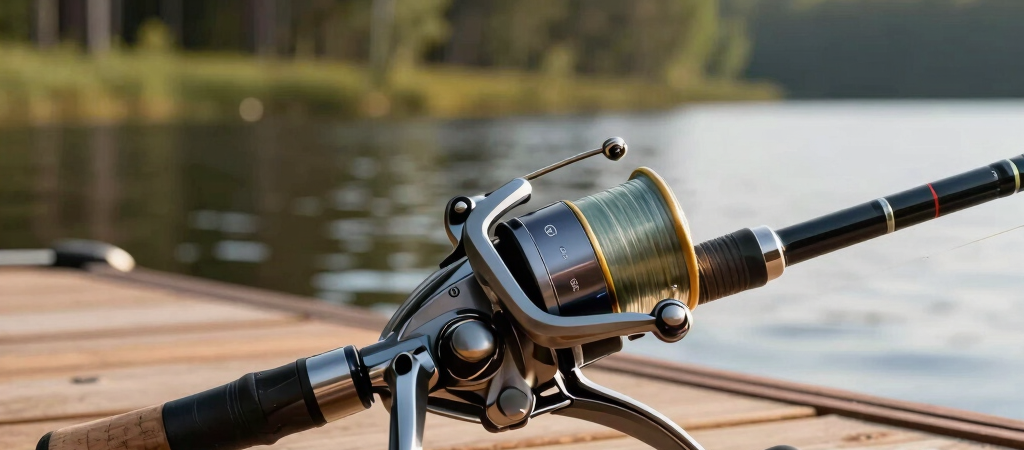
The short answer: for a first bass setup on spinning gear, the sources we read converge on a medium-power, fast-action rod of about 6’6″ to 7′, a size 2500 reel (2000 to 3000 depending on the source), a gear ratio around 5:1 to 6:1, and 8 to 12 pound monofilament or fluorocarbon. Braid is a fine upgrade later. The rest of this guide shows how those pieces fit together, where the sources disagree, and how to check each number on a real listing before you buy.
Disclosure: some links on this site may be affiliate links. If you buy through them, we may earn a commission at no extra cost to you.
Quick picks: the starting setup in one table
Three guides cover this ground: Tackle Warehouse’s “How to Choose Your First Reel” for bass fishing, West Marine’s spinning reel guide by Brian Vanderlaan, and Daiwa’s spinning reel guide. We also use Sports Illustrated’s bass guide by Justin Hoffman for rod and reel sizes. Each states the numbers a little differently, so the table shows who says what.
| Piece | Starting point | What the sources say |
|---|---|---|
| Reel size | 2500 | Tackle Warehouse recommends 2500; West Marine puts black bass in the 2500 to 3000 range; Sports Illustrated suggests 2000 or 2500 |
| Rod | 6’6″ to 7′, medium power, fast action | Tackle Warehouse gives 6’6″ to 7′; Sports Illustrated suggests a 7′ medium-action rod, or 7’2″ medium-heavy for heavy cover |
| Gear ratio | 5:1 to 6:1 | Tackle Warehouse recommends this range; West Marine says most spinning reels fall between 4.8:1 and 6.2:1 |
| Line | 8 to 12 lb mono or fluorocarbon | West Marine’s size chart lists 8 to 12 lb mono for 2500 to 3000 reels; Tackle Warehouse recommends mono or fluorocarbon first; Sports Illustrated prefers braid around 15 lb |
| Drag | About 20% to 30% of the line’s breaking strength | West Marine’s general rule |
What the reel numbers mean
Spinning reels are sized with numbers such as 1000, 2500 or 4000. West Marine says the scale runs from 1000 to 30000 and warns that the numbers are not standardized between brands, although they are consistent within one maker’s lineup. Daiwa explains the practical meaning: the higher the number, the larger the reel, with more line capacity and more drag power. That means a 2500 from one brand and a 2500 from another can differ a little in body size, so treat the number as a family, not an exact measurement.
West Marine’s size chart is the most useful for bass. It lists 1000 to 2000 reels for 4 to 8 pound mono and ultralight work such as trout, panfish and crappie. It lists 2500 to 3000 reels for 8 to 12 pound mono and light freshwater fishing, naming black bass among the target species. Reels from 4000 up are in the 12 to 20 pound class and above, aimed at larger saltwater species. Daiwa’s chart is written for its European market, so it names other fish, but the pattern is the same: 1000 to 2500 for light freshwater and 3000 to 4000 for bigger fish such as pike.
Here is where the three bass-specific sources land. Tackle Warehouse recommends a 2500 with a medium-size spool that works with braid, mono and fluorocarbon. Sports Illustrated suggests a 2000 or 2500 for most baits. West Marine says 2500 to 3000. The overlap is clear: 2500 is the safe middle. If you are torn between two sizes, West Marine’s author advises choosing the larger one, which is a reasonable tiebreaker if you plan to use heavier line or bigger lures.
Match the reel to the rod
A reel is only half of the setup, and every guide we read stresses balance. West Marine explains that rods are rated for a range of line weights and lure weights, and gives an example: a rod rated for 8 to 17 pound line and 3/8 to 1 ounce lures pairs with a 3000 to 4000 reel. It also says never to spool line heavier than the rod’s rating, because the rod can break on a hard hookset or a strong fish. Daiwa adds that longer rods pair with slightly larger, heavier reels because they give more leverage, while shorter rods pair with smaller, lighter ones.
Balance is the other half. According to Daiwa, a reel that is too light can feel unbalanced, and one that is too heavy tires your wrist over a long day. When the pair is matched, the outfit feels neutral in the hand, which improves sensitivity and reduces strain. West Marine makes the same point from the other side: an oversized reel unbalances the rod and wears you out on repeated casts.
For the rod itself, Tackle Warehouse recommends a spinning rod of 6’6″ to 7′ with medium power and a fast taper. Sports Illustrated gives a specific pairing for most baits: a 7-foot medium-action rod with a 2000 or 2500 reel. For heavy cover, it suggests a 7’2″ medium-heavy rod. FishUSA, in its bass guide, says a medium spinning rod suits finesse presentations, while jigs, spinnerbaits and crankbaits call for a medium-heavy baitcasting rod. That is a useful reminder of what a spinning outfit is best at: lighter lures and subtler presentations.
If you are buying a combo, our rod and reel combo guide covers how to read the spec lines. The same rule applies here: check that the listing states the reel size and the rod’s line and lure ratings, and compare them with the line you plan to use.
Gear ratio: slower and stronger, or faster and lighter
The gear ratio tells you how many times the rotor circles the spool for each turn of the handle. West Marine’s example: 6.2:1 means 6.2 rotor turns per handle turn. It says most spinning reels sit between 4.8:1 and 6.2:1, with some baitcasting reels reaching 8.1:1 or more. Tackle Warehouse recommends 5:1 to 6:1 for beginners and notes that some makers offer 7:1 and above, which helps in deeper water because it shortens the retrieve.
Daiwa explains the tradeoff. A lower ratio retrieves more slowly with more power, which suits heavier lures, slow presentations and strong fish. A higher ratio retrieves faster, which helps when you fish actively, pick up slack or keep tension on a fish that swims toward you. For beginners, Daiwa recommends starting with a standard ratio because it is easier to speed up your reeling than to slow it down.
Both Daiwa and West Marine add a caveat that is easy to miss: spool diameter affects speed too. A larger spool picks up more line per turn even with the same ratio, so the most useful number is how many inches of line the reel retrieves per crank. If a listing gives that figure, use it to compare models. In our combo guide, the Ugly Stik Carbon lists 5.1:1 and the PENN Pursuit IV 4000 lists 6.2:1, so both fall inside the range these sources describe.
Line: where the advice splits
The three sources do not give identical advice on line, and that is useful to see in one place.
| Source | Line suggestion | Reason given |
|---|---|---|
| Tackle Warehouse | Start with monofilament or fluorocarbon; later, a braid main line with a fluorocarbon leader | Simplest to spool; braid and leader add sensitivity |
| West Marine | 8 to 12 lb mono for 2500 to 3000 reels | Matches the reel size to line strength |
| Sports Illustrated (bass guide) | Braid for beginners, about 15 lb on spinning gear | Sensitivity and handling around cover |
How should a beginner choose? The sources agree on the sizes and differ on the material. Mono or fluorocarbon is the lowest-risk first spool, which matches the advice in our guide to mono, fluorocarbon and braid. Braid is a good fit when you fish heavy cover or want more sensitivity, and Tackle Warehouse notes that “braid-ready” spools are shallower so that thin line does not slip under pressure. If you plan to use braid on a mono-style spool, our line guide covers backing and spooling.
One reason braid is popular on spinning reels is capacity. West Marine points out that braid is much thinner than mono of the same strength, using the example that a spool holding 200 yards of 20 pound mono could hold more than 300 yards of 20 pound braid. Heavier line takes up more room, so a reel with plenty of capacity for 8 to 12 pound mono has less room if you step up to thicker line. Always stay within the line range printed on the reel spool and the rod blank.
Set the drag before you fish
The drag is the clutch that lets line slip when a fish pulls hard. Tackle Warehouse explains the basic control: on most spinning reels it is a knob on top of the spool, and turning it clockwise tightens it while counterclockwise loosens it. West Marine gives a number to start from: set the drag to about 20% to 30% of the line’s breaking strength, and confirm it with a handheld spring scale instead of relying on feel. Its example is 20 pound line, which would be set at 4 to 6 pounds.
Applying the same rule, we calculate that 10 pound line would be set at about 2 to 3 pounds. That is our arithmetic from West Marine’s percentage, not a figure from the source. Daiwa takes a more practical view for beginners. It says a smooth, consistent drag matters more than a very strong one, because stuttering drag makes it hard to keep steady pressure on a fish, and it suggests tightening until line comes off when you pull firmly but not violently. Front drags, the knob on top of the spool, give more control and smoothness than rear drags, according to Daiwa. West Marine adds that front drags usually deliver higher maximum force and more consistent pressure.
Bearings, body and price: what matters
Bearing counts are a common marketing number, and the sources are skeptical. West Marine says more bearings generally mean smoother operation but that quality matters more than quantity, giving the example of six good ABEC-5 bearings beating ten poor ones. Daiwa says the same: a few well-made, well-placed bearings usually outperform many cheap ones, and smoothness under load matters more than how a reel feels in the store. West Marine also mentions anti-reverse bearings, which remove handle slack when the drag is engaged for a more direct hookset.
On materials, West Marine says graphite or composite bodies are light and resist corrosion but flex more under heavy load, which can affect drag consistency. They are common in freshwater and entry-level reels. Aluminum bodies and rotors are stiffer and more durable with more consistent drag under load, at the cost of weight. For price, West Marine describes entry-level reels as typically having graphite bodies, felt drag washers and chrome bearings, while mid-priced reels add more bearings, carbon drag washers and aluminum or composite bodies. That is a retail guide, so it may not match every market, but the pattern is helpful when you compare listings.
A starter bass setup to check against
This setup is our editorial suggestion, built from the overlap in the sources above, not a recommendation from any one of them.
- Rod: 6’6″ to 7′, medium power, fast action, with a line rating that includes 8 to 12 pound line.
- Reel: size 2500, with a gear ratio of 5:1 to 6:1 and a front drag.
- Line: 8 to 12 pound monofilament or fluorocarbon.
- Drag: about 20% to 30% of the line’s breaking strength, set before you fish.
- First lures: Tackle Warehouse suggests drop shot rigs, the ned rig and a weightless wacky-rigged worm, all light presentations that suit spinning gear.
If you fish heavy cover or want to throw heavier lures, step up in rod power and line strength, as Sports Illustrated and FishUSA suggest, or move to baitcasting later.
Common mistakes when choosing a spinning setup
- Buying the reel and rod separately without checking sizes. The reel should match the rod’s line and lure ratings.
- Choosing by bearing count. Two sources say quality matters more than the number.
- Putting heavier line on than the rod allows. West Marine warns the rod can break.
- Skipping the drag setting. Set it before you fish, not after a fish is on.
- Overfilling or underfilling the spool. Leave a small gap at the lip, as our line guide explains.
- Picking braid first for the wrong reason. It is sensitive, but it is less forgiving than mono for a beginner.
Your pre-purchase checklist
- Pick a rod of 6’6″ to 7′ with medium power and fast action.
- Look for a size 2500 reel, or 3000 if you want a larger spool.
- Check the gear ratio (5:1 to 6:1) and, if listed, inches of line per crank.
- Confirm the rod’s line rating and the reel’s line capacity match your line.
- Choose mono or fluorocarbon first, and braid later.
- Plan to set the drag at about 20% to 30% of the line’s strength.
- Check that the listing states what line, if any, is included.
How we researched this
This guide is based on published articles and public information. We have not tested these setups ourselves. We read guides from Tackle Warehouse (March 2024, updated April 2025), West Marine (Brian Vanderlaan, updated February 2026), Daiwa Scandinavia (January 2026), Sports Illustrated (September 2025) and FishUSA (March 2025), and we list each source below. Reel sizes are not standardized between brands, so the numbers are starting points. Specifications and availability change, so confirm details on the listing before you buy.
FAQ
What size spinning reel is best for bass?
Size 2500 is the common recommendation. Tackle Warehouse recommends it, Sports Illustrated suggests 2000 or 2500, and West Marine places black bass in the 2500 to 3000 range.
What gear ratio should a beginner choose?
Tackle Warehouse recommends 5:1 to 6:1. Daiwa says a standard ratio is a good start because it is easier to retrieve faster than slower.
What line should I put on a spinning reel for bass?
Tackle Warehouse suggests monofilament or fluorocarbon to start, and West Marine lists 8 to 12 pound mono for 2500 to 3000 reels. Sports Illustrated recommends braid of about 15 pounds. See our line guide for the tradeoffs.
How do I set the drag?
West Marine suggests about 20% to 30% of the line’s breaking strength, checked with a spring scale. Daiwa says a smooth drag matters more than a strong one.
Do more bearings make a better reel?
Not by themselves. West Marine and Daiwa both say bearing quality matters more than the number.