
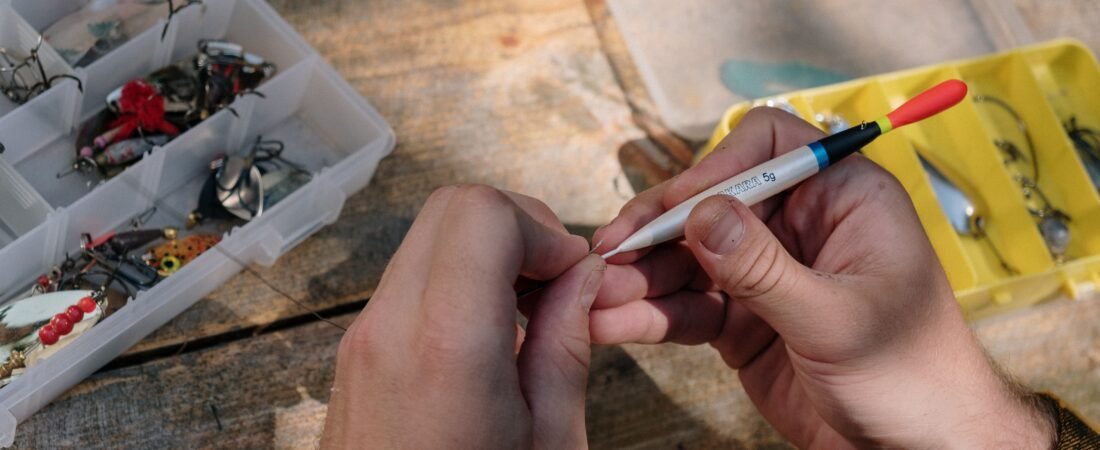
The short answer: learn the Palomar knot first. Field & Stream’s Joe Cermele writes, “If you only ever learn one fishing knot, make it the Palomar,” and lists it for mono, fluorocarbon, braid and super line. FishTalk’s Eric Packard calls it, in his opinion, the fastest knot for tying a lure onto your line or leader, and the Utah Division of Wildlife Resources says it is especially suited to large hooks and braided line. Add the improved clinch and the uni knot, and you can tie on almost anything a beginner will use.
Disclosure: some links on this site may be affiliate links. If you buy through them, we may earn a commission at no extra cost to you.
Quick picks: which knot for which job
| Job | Knot | Notes from the sources |
|---|---|---|
| Tying on a hook, lure or swivel with any line | Palomar | Field & Stream lists all line types, roughly 2 to 50 lb test |
| Light mono or fluorocarbon, most light freshwater | Improved clinch | Field & Stream says roughly 4 to 20 lb and not for braid |
| Stronger connection, heavier line or braid | Uni | Field & Stream lists roughly 10 to 80 lb |
| Joining a leader to a main line | Double uni | Utah DWR and FishTalk both describe it |
| Giving a lure freer movement | Non-slip mono loop or Rapala loop | Loop knots let the lure swing |
| Single hook with bait | Snell | Mono and fluorocarbon only, never braid |
Before you tie anything: three habits
All three guides agree on a few habits that matter more than the specific knot.
- Moisten the knot before you tighten it. The Utah DWR guide says to wet it with saliva or water because it helps the knot seat and reduces friction heat that can weaken the line. Field & Stream says the same, with lip balm as an alternative. The FishTalk article does not mention it.
- Trim the tag end after the knot is seated. Field & Stream says to trim it close once it is tight. FishTalk says to pull each knot tight before trimming.
- Do not glue coil knots. Field & Stream warns that glue on knots like the uni or clinch stops them from tightening under load. Glue is more common on line-to-line connections.
There is also one rule for heavy line. For monofilament or fluorocarbon heavier than about 60 pounds, Field & Stream says to use a crimp sleeve instead of a knot.
Knot 1: The Palomar
When to use it: attaching line to hooks, lures or swivels. It is strong, simple and works with all line types. Field & Stream lists a range of roughly 2 to 50 pounds, and notes that heavy mono and fluorocarbon can be hard to seat, so lubricating helps.
How to tie it, based on the Utah DWR and FishTalk steps:
- Double the line to make a loop.
- Pass the loop through the eye of the hook, lure or swivel.
- Tie a loose overhand knot with the doubled line, so the hook hangs from the loop.
- Pass the loop over the entire hook, lure or swivel.
- Moisten the knot, then slowly pull both ends to tighten, and trim the tag end.
The Palomar is easy to remember because the shape is just an overhand knot with a loop you drop over the hook. The step beginners miss most often is passing the loop over the whole hook. Without that step, you have only tied an overhand knot, and it will slip.
Knot 2: The improved clinch
When to use it: attaching line to hooks, lures or swivels on light line. Field & Stream says it works with mono and fluorocarbon in the range of about 4 to 20 pounds, suits most freshwater and light inshore saltwater fishing, and is easy to learn.
How to tie it, per the Utah DWR and FishTalk steps:
- Pass the line through the eye.
- Wrap the tag end around the main line five or six times.
- Pass the tag end through the small loop nearest the eye.
- Then pass it through the new, larger loop you just formed.
- Moisten the knot, hold the tag end, and pull the main line tight. Trim the tag end.
Where the sources disagree: the Utah DWR guide says the improved clinch works with monofilament, fluorocarbon and braided line. Field & Stream warns not to use it with braid or super line because the coils can slip. FishTalk describes it for monofilament. When guides disagree, take the cautious route. If you are fishing braid, use the Palomar or the uni instead.
Knot 3: The uni knot
When to use it: attaching line to lures, flies or swivels. Utah DWR says it suits monofilament and fluorocarbon, while Field & Stream lists mono, fluorocarbon and heavier braid in roughly the 10 to 80 pound range. It is also the basis for joining lines, in the form of the double uni.
How to tie it, based on the Utah DWR steps:
- Pass the line through the eye and double it back alongside the main line to form a loop.
- Wrap the tag end around the doubled line and through the loop about six times.
- Moisten the knot and pull the tag end to tighten.
- Slide the knot down to the eye, then trim.
Field & Stream notes that the wraps tighten onto the main line first and then slide down to the eye, making the uni stronger than the clinch. The caveat is that on thin, slick braid under extreme strain, the line can cut through the coils.
Knot 4: The double uni, for joining two lines
When to use it: joining a leader to a main line, or two lines of different types. Utah DWR says a double uni can join two lines or a line and a leader. FishTalk uses it for connecting a leader to braid, and says Packard prefers it over the FG and Blood knots because it is quicker to tie.
How to tie it, based on FishTalk:
- Hold the two lines side by side, overlapping, and form a loop in each end.
- Wrap one tag end around both lines five to seven times to make a uni knot, passing it through its loop.
- Repeat with the other tag end, wrapping the opposite line.
- Pull both tag ends snug.
- Pull on the two main lines so the knots slide together and seat against each other.
- Trim the tag ends.
Because this knot joins two different lines, test it before you trust it. Realtree notes that knot tying is difficult with heavy fluorocarbon, and that many common knots are nearly impossible to tie on lines rated over 30 pounds, so check how the connection holds with your actual line sizes.
Knot 5: A loop knot for lure action
When to use it: when you want a lure to swing freely instead of being locked tight to the line. Field & Stream describes the non-slip mono loop as tying above the eye so a lure or fly can pivot, and says it is best for lures without split rings and for swimming streamers. It lists mono and fluorocarbon, roughly 12 to 60 pounds. FishTalk describes a Rapala knot, a loop that gives a jig more action, with steps that begin with a loose overhand knot and then pass the end through the eye and back through the overhand.
Loop knots are slightly more advanced than the first three. Field & Stream notes the non-slip loop is only as strong as the line and should not be used on very light line. Add it to your list after the Palomar feels automatic.
Which knot for which line
Line type is the deciding factor. Field & Stream’s chart is the most specific, so this table follows it and flags where others differ.
| Knot | Monofilament | Fluorocarbon | Braid |
|---|---|---|---|
| Improved clinch | Yes, about 4 to 20 lb | Yes | Avoid (Field & Stream); Utah DWR lists it as working |
| Palomar | Yes | Yes | Yes (all three sources) |
| Uni | Yes | Yes | Heavier braid only; slick thin braid can cut the coils |
| Non-slip mono loop | Yes, about 12 to 60 lb | Yes | Not listed |
| Snell | Yes, about 15 to 50 lb | Yes | Never |
For a deeper look at how the lines themselves differ, see our guide to mono, fluorocarbon and braid.
Common knot mistakes
Field & Stream lists several errors that apply to every beginner.
- Using the improved clinch with braid or super line. The coils can slip.
- Using the uni with very thin, slick braid under heavy strain. The line can cut through the coils.
- Failing to seat thick mono or fluorocarbon properly in the Palomar or clinch.
- Using the non-slip loop on very light line.
- Gluing coil knots, which locks them in place.
Also avoid tying in a hurry. The Utah DWR guide says to take your time so each knot is tied correctly, and to practice regularly to improve both quality and confidence.
How to practice
This part is our editorial suggestion, not from the sources. Tie each knot on a hook while you are sitting at a table, not on the water at dawn. Use a spare hook with the point snipped or pushed into a cork, and use line a little heavier than you normally fish so the loops are easier to see. Tie the Palomar ten times in a row until you can do it without thinking about it. Then do the same for the improved clinch, and then the uni. After each knot, pull firmly on the main line and see whether it holds. If a knot slips, check the three habits: wet it, seat it and trim it.
Your knot checklist
- Learn the Palomar first.
- Keep a short spool of the line you fish for practice.
- Moisten every knot before tightening.
- Trim the tag end after the knot is seated.
- Do not glue coil knots.
- Use a crimp sleeve for mono or fluorocarbon heavier than about 60 pounds.
- If you fish braid, choose the Palomar or uni over the improved clinch.
How we researched this
This guide is based on published articles and public information. We have not tied these knots in test conditions or measured their breaking strength. We read the Utah Division of Wildlife Resources blog (February 2025), Field & Stream (June 2024), FishTalk Magazine (undated) and Realtree (May 2024), and we list them below. The weight ranges come from Field & Stream and we present them as that source’s figures. Where the guides disagree, such as using the improved clinch with braid, we say so.
FAQ
What is the easiest fishing knot for a beginner?
Field & Stream recommends learning the Palomar first, and Utah DWR says it is especially suited to large hooks and braided line. FishTalk’s Packard calls it, in his opinion, the fastest knot for tying a lure onto your line or leader.
Can I use an improved clinch knot with braid?
The sources disagree. Utah DWR lists the improved clinch with braided line, while Field & Stream warns the coils can slip with braid or super line. The safer choice is the Palomar or uni knot.
Should I wet the line before I tighten the knot?
Yes, according to Utah DWR and Field & Stream. Moisture helps the knot seat and reduces friction heat that can weaken the line.
Do I need to trim the tag end?
Yes. Field & Stream says to trim the tag end close once the knot is seated. FishTalk also says to trim after tightening.
How do I join two lines?
Utah DWR and FishTalk describe the double uni knot for joining two lines or a line and a leader. Test it with your actual line sizes before you rely on it.