
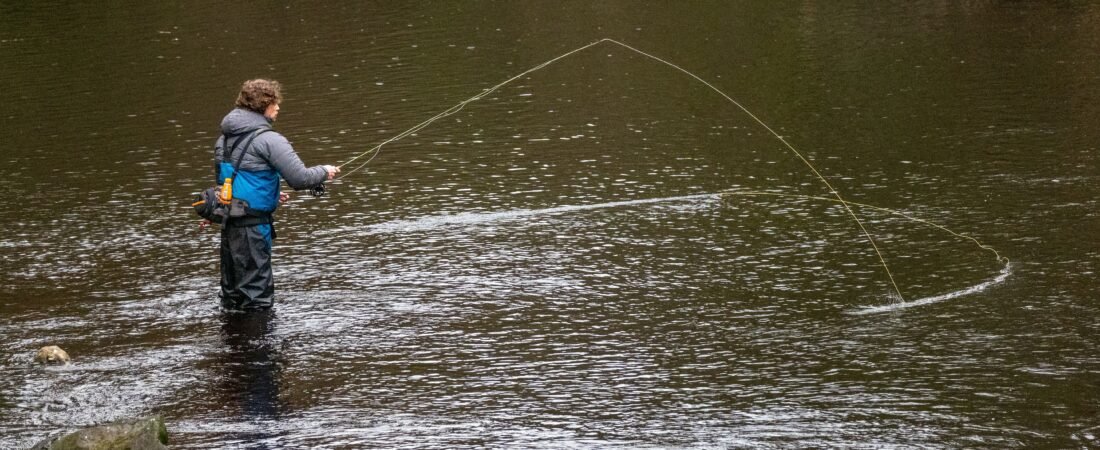
The short answer: for fly fishing for beginners, pick the rod weight by the fish, not by a universal answer. Published guides point to a 9-foot, 5-weight for trout and general freshwater, and a 6- or 7-weight for bass. Add a matched reel, a floating weight-forward line, a 9-foot leader, tippet and a few flies.
Disclosure: some links on this site may be affiliate links. If you buy through them, we may earn a commission at no extra cost to you.
In this guide:
- Fly fishing for beginners: what to buy first
- Why the rod weight advice conflicts
- What the sources agree on
- Rod length and action
- Outfit or separate parts, and what it costs
- The line system, step by step
- Flies to start with
- Small tools you will use constantly
- Waders, life jackets and licenses
- Where to find fish
- Learning to cast
- A starter plan (our suggestion)
- Common beginner mistakes
- How we researched this
- FAQ
Fly fishing for beginners: what to buy first
Start with a rod, reel and line that match each other, then add a leader, tippet, flies and a few small tools. Everything else can wait. MidCurrent’s Marshall Cutchin puts the approach plainly: get a basic, well-rounded setup and do not fret over the details.
The table below is our summary of the order in which the sources build a first setup. Details for each item follow in the sections after it.
| Step | What you need | Where it is covered |
|---|---|---|
| 1 | Rod, matched to the fish you want | Rod weight and length sections |
| 2 | Reel and line that match the rod weight | The line system |
| 3 | Backing, leader and tippet | The line system |
| 4 | Two or three flies | Flies to start with |
| 5 | Nippers, forceps, net, sunglasses | Small tools |
| 6 | License, life jacket, waders only if you wade | Waders, life jackets and licenses |
Our summary of the sources reviewed for this guide.
Why the rod weight advice conflicts
The advice conflicts because the guides write for different fish. Fly rods are rated by a number, and Gear Patrol’s Ed Estlow explains what it means: rods are rated by line weight on a scale of 1 to 12, a number assigned to the physical weight of the last 30 feet of fly line. A higher number means a heavier line and a stiffer rod, generally for bigger flies and bigger fish. Here is what each source says:
| Source | Rod weight advice | Context |
|---|---|---|
| Gear Patrol (Ed Estlow, 2013, updated 2021) | 5-weight | Covers most freshwater situations |
| CampSaver (Brett R., 2022) | 9-foot, 5-weight | Trout in lakes and rivers |
| CampSaver (Brett R., 2022) | 9-foot, 8-weight | Saltwater, such as sea trout and striped bass |
| MidCurrent (Marshall Cutchin, 2022) | 9-foot, 5-weight | Trout and other freshwater fish |
| Sierra Magazine (Robert Annis, 2022) | 4- or 5-weight | Trout or smallmouth bass |
| Take Me Fishing (2017) | 6- or 7-weight | Largemouth bass |
| Take Me Fishing (checklist) | 6-weight or 7-weight | Called two of the most versatile weights |
Once you see the context, the disagreement mostly disappears. The 4- or 5-weight advice is for trout and general freshwater fishing, the 6- or 7-weight advice is for bass and larger flies, and the 8-weight is for saltwater species. The practical rule is simple: choose the weight by target fish. If you plan to fish for bass, our bass fishing for beginners guide covers the fish itself.
What the sources agree on
Despite the weight differences, the guides agree on several points:
- Match the reel to the rod. Take Me Fishing says a 7-weight rod gets a 7-weight reel, Gear Patrol says the rod and reel should be balanced, and MidCurrent warns against mismatching the reel to the rod and line weight.
- Use a floating, weight-forward line. Take Me Fishing recommends a floating weight-forward taper because it is easier to cast, and Gear Patrol recommends a weight-forward line, giving a WF-5F as the example for a 5-weight setup, where F means floating. Gear Patrol does not recommend sinking lines for beginners.
- Start with a few versatile flies. Take Me Fishing suggests two or three patterns instead of a huge assortment.
- Get help early. Gear Patrol’s main casting advice is to visit a fly shop and take a few casting lessons, and the 2023 Take Me Fishing article suggests a local guide, an intro clinic or an experienced friend.
Rod length and action
A nine-foot rod is the most common starting point in the guides, with medium or fast action. CampSaver recommends nine feet, saying that length balances casting distance and maneuverability for beginners, and that longer rods cast farther but are harder to handle. MidCurrent also recommends a lower-priced 9-foot graphite rod for beginners.
Sierra Magazine adds a water-based rule: an 8- to 9-foot rod suits small creeks, while longer rods work better on large waters. CampSaver recommends medium or fast action. Take Me Fishing (2017) and Gear Patrol do not state a length.
Outfit or separate parts, and what it costs
You can buy a matched outfit or assemble parts one by one, and the sources do not say one is always better. Sierra Magazine says starter kits run about $50 and high-end gear costs hundreds or more. It suggests a mid-range setup for beginners, with kits around $200 that include a plastic reel and a case. MidCurrent says fly rods range from under $100 to well over $1,000, and that gear is now generally cheaper and often better than it was 10 to 20 years ago.
Many reels come pre-spooled with line and backing, according to Sierra Magazine, but you still need leaders and tippet to connect the line to the fly. The 2023 Take Me Fishing article says fly shop starter kits include a rod, reel, backing and line already set up, and that you will still need a net, tippet, flies and, for wading, waders. It also says some items can be rented for the day.
| Item | What the sources say | Price signal (2022 sources) |
|---|---|---|
| Starter kit (rod, reel, line) | Sets up a basic outfit; add leader, tippet and flies | About $50 for basic, about $200 mid-range (Sierra Magazine) |
| Rod alone | Wide range | Under $100 to over $1,000 (MidCurrent) |
| Flies | Many are cheap; buy an assortment | Many cost $1 to $3 each (Sierra Magazine) |
| Waders and wading boots | A significant investment; can wait | No figure used here |
| Rental | Some items can be rented for a day | Ask a local fly shop (Take Me Fishing, 2023) |
This table is our editorial summary of those articles. Prices are from 2022 and may have changed, so treat them as a rough sense of scale rather than a quote.
The line system, step by step
A fly setup is a chain of parts, and each one has a job. This is where beginners get lost, so here it is in order from the reel outward.
- Backing. Take Me Fishing says to add about 100 yards of Dacron to the reel arbor before the fly line, to provide backup line during long runs and to help prevent memory coils. Gear Patrol recommends 100 to 200 yards of 20-pound-test Dacron. MidCurrent says the reel needs room for about 30 yards of backing, so the amounts differ by source and by reel.
- Fly line. Match its weight to the rod. CampSaver adds that the line should match the rod within one unit, so a five-weight rod pairs with a four-, five- or six-weight line. Gear Patrol says fly lines come in weight-forward or double-taper forms, about 90 feet long. MidCurrent suggests a 5-weight, weight-forward floating line for a 5-weight rod.
- Leader. Take Me Fishing says to use about 9 to 10 feet, and to buy a knotless tapered leader or build one, starting with the heaviest material for the butt section and tapering down with two or three lighter sections. Gear Patrol says the leader tapers and is made of monofilament. MidCurrent suggests a basic 9-foot leader.
- Tippet. Take Me Fishing’s earlier article describes tippet as the thinnest section at the end of a tapered leader, which attaches to the fly. Gear Patrol describes it as the final couple of feet that does not taper, and says to buy spools in 3X, 4X, 5X and 6X. MidCurrent starts with 5X.
- Fly. The business end.
The knots that join these parts are their own topic; see our guide to essential fishing knots for beginners for general knot basics, and ask a fly shop which knots they use for leader and tippet.
Reading the X numbers
Gear Patrol gives a formula for tippet diameter: subtract the X number from 0.011 inches. Its example is 5X, which comes to 0.006 inches. By the same formula, 4X is 0.007 inches and 6X is 0.005 inches. Higher X means thinner tippet, which suits smaller flies and wary fish.
CampSaver also gives a rule of thumb for matching leader size to fly size, but we could not confirm it against a manufacturer chart, so we do not repeat it. If you want to size tippet to a fly, check a manufacturer chart or ask the fly shop before you rely on a single rule.
Flies to start with
Start with two or three versatile patterns and add more only when the water tells you to. Take Me Fishing suggests the Woolly Bugger, the Clouser Deep Minnow and the Dahlberg Diver. Its checklist suggests a Clouser minnow pattern or a topwater popping bug, which it says work in freshwater or saltwater.
MidCurrent suggests a small assortment of dry flies, nymphs, streamers, wet flies and terrestrials, and notes that dry flies are a common first choice because you can see when a fish takes the fly. Sierra Magazine says many flies cost $1 to $3, so an assortment is affordable, and advises asking a local fly shop which patterns are working nearby.
CampSaver advises matching the fly’s size, movement, color and shape to the natural insect or prey, asking local bait shops or anglers which flies work, or sampling nymphs and insects from the river to imitate. Gear Patrol mentions floatant for dry flies and split shot to sink wet flies.
Notice that the pattern names Take Me Fishing lists are streamers and a topwater bug, which suits bass and similar fish. If you are fishing small trout streams, the local advice from CampSaver and Sierra Magazine becomes more important.
Small tools you will use constantly
A few cheap tools get used on every trip. Take Me Fishing lists several accessories:
- Line nippers or snips for cutting leader and tippet. The earlier article describes machined aluminum or stainless steel jaws, with an optional needle for clearing hook eyes. MidCurrent suggests nippers with a retractor.
- Hemostats or forceps for removing flies from fish, crimping barbs and holding small flies. The checklist notes that crimping barbs makes catch and release easier.
- A landing net. The earlier article says rubberized or silicone nets help keep the fish’s slime coat intact.
- Polarized sunglasses. The checklist says they protect against UV rays and cut surface glare so you can see fish and cast accurately.
- Floatant and a fly box. MidCurrent lists floatant for dry flies and a fly box to keep patterns organized.
For releasing fish, Sierra Magazine says to keep fish wet, handle them only with a rubber net or wet hands, and release them quickly, because time out of water stresses fish. It also suggests carrying a small resealable bag for monofilament scraps and trash so they do not end up in the water.
Waders, life jackets and licenses
You do not need waders for a first outing, but you do need a license, and a life jacket if you fish from a boat or kayak. Most states require a fishing license, and the rules vary by state, age and waterbody. Check your state wildlife agency’s website before your first trip.
Take Me Fishing’s checklist says to wear a U.S. Coast Guard approved PFD when fishing from a boat or kayak and, for rivers and streams, to learn wader safety and buy waders suited to the waterway. Sierra Magazine calls waders and wading boots a significant investment, says you can fish from the riverbank first, and says that in warm water shorts and water shoes with good traction are enough.
If you do wade, Sierra Magazine says to check water levels before you wade or float. Think about water depth and current before you step in. This is general information, not safety advice.
Sierra Magazine also notes that access rules vary by state. Some states allow wading through private property where a river passes, while others do not, so ask a local shop or guide before you cross anyone’s land.
Where to find fish
Look for fish where they find cover from predators and current. CampSaver says trout hold under overhanging branches, in undercut banks, and behind rocks in fast water. It is a good reminder that fly fishing is partly about reading water, and a lesson or a local shop can speed that up.
Water conditions matter too. Our guide to the best time and weather to fish covers how the day and the weather change where fish hold.
Learning to cast
Casting is the main skill, and the quickest way to learn it is with someone who can watch your cast. The 2023 Take Me Fishing article lists three routes: hire a local guide through a fly shop, join an intro clinic run by an organization or a fly shop, or learn from an experienced friend. It also points to free videos from fly fishing brands and online creators.
You can also practice at home. CampSaver suggests an open area on land, and Sierra Magazine suggests practicing the basic cast in a yard or park without a hook, and says some retailers sometimes offer free introductory classes. Be aware of your surroundings, since a fly line can catch on trees and people.
Spend time on the water, too. The 2023 Take Me Fishing article suggests reading online fishing reports and talking with shop staff, who can recommend flies and leader or tippet for current conditions.
A starter plan (our suggestion)
This section is our editorial suggestion, not from the sources. Decide the fish first. If it is trout in streams, the sources point toward a nine-foot, five-weight. If it is bass in ponds, a 6- or 7-weight with larger flies.
Buy a matched outfit in that weight, or ask a fly shop to set up the backing, line and leader. Add a tapered leader of about nine feet, spools of tippet, a few flies, nippers and forceps. Take a casting lesson before spending more.
Resist the urge to buy a second rod until you know what you are missing. Rent waders or fish from the bank before you buy them.
Common beginner mistakes
Most mistakes come from buying before deciding what to fish for, or from skipping practice.
- Buying a rod before choosing the fish. The weight advice depends on what you fish for.
- Mismatched reel and line. The sources say to match weights.
- Choosing sinking line first. Gear Patrol does not recommend it for beginners.
- Skipping backing. Take Me Fishing and Gear Patrol both list it.
- Buying too many flies. Take Me Fishing suggests two or three patterns to start.
- Overthinking the details. MidCurrent advises a basic, well-rounded setup.
- Skipping the lesson. Gear Patrol’s main casting advice is to take one.
How we researched this
This guide is based on published articles and public information. We have not cast or tested any fly gear ourselves. Prices and gear details may have changed, and where the sources differ, such as on rod weight, we say why. We read the following:
- Take Me Fishing, “Fly Fishing Equipment: 9 Essentials for Beginners” (November 2017).
- Take Me Fishing, “Beginner Fly Fishing Gear Checklist: 10 Essentials for Getting Started” (December 2018, no visible date).
- Take Me Fishing, Melissa Ceren, “Starting a Lifelong Passion: Intro to Fly Fishing” (March 23, 2023).
- Sierra Magazine, Robert Annis, “How to Get Started With Fly-Fishing” (August 6, 2022).
- MidCurrent, Marshall Cutchin, “Fly Fishing Gear for Beginners” (May 17, 2022, modified August 24, 2022).
- Gear Patrol, Ed Estlow, “A Beginner Fly Fisherman’s Primer” (June 2013, updated June 2021).
- CampSaver, Brett R., “Fly Fishing Tips for Beginners” (September 2022).
CampSaver is a retailer and Gear Patrol is a gear publication, so we use them for general criteria, numbers and categories, not product recommendations. We do not recommend any brand or model.
FAQ
What weight fly rod should a beginner buy?
It depends on the fish. Gear Patrol and MidCurrent recommend a 5-weight for general freshwater, CampSaver suggests a nine-foot, five-weight for trout, and Take Me Fishing suggests a 6- or 7-weight, with bass as its example.
What is the difference between leader and tippet?
Per Gear Patrol, both are monofilament. The leader tapers, while the tippet is the final couple of feet and does not taper.
What does 5X tippet mean?
Gear Patrol says to subtract the X number from 0.011 inches to get the diameter, so 5X is 0.006 inches. A higher X means thinner tippet.
How much does beginner fly fishing gear cost?
Sierra Magazine (2022) puts basic starter kits at about $50 and mid-range kits around $200, while MidCurrent says rods alone run from under $100 to over $1,000. Prices may have changed, and waders, flies and tippet cost extra.
Do I need a fishing license for fly fishing?
In most states, yes, but the rules vary by state, age and type of water. Check your state wildlife agency’s website for current requirements before you fish.