
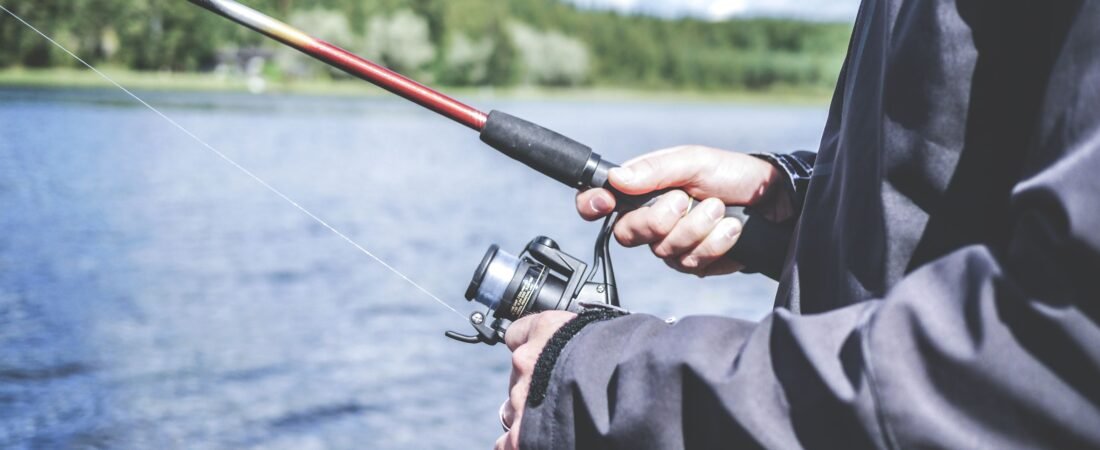
The short answer: casting a spinning reel comes down to four things: hold the line against the rod with your index finger, open the bail, swing the rod back and forward in one smooth motion, and let go of the line at the right moment. Then close the bail by hand. Everything else is practice, and the release timing is the part that takes the longest to feel.
Disclosure: some links on this site may be affiliate links. If you buy through them, we may earn a commission at no extra cost to you.
The eight-step cast
Three published guides describe the same basic cast with small differences. This version combines them. Read it once, then try it in a yard or park rather than at the water’s edge.
- Face the target. Mystery Tackle Box suggests turning your whole body, shoulders, hips and feet, toward where you want the lure to land.
- Hold the rod level. Take Me Fishing says to hold the rod at about waist height with the reel underneath. The Art of Manliness describes the rod as horizontal with the reel facing the ground.
- Set the line length. Let a short length of line hang from the rod tip. The sources give different lengths, so see the next section.
- Pin the line. Hook the line with your index finger and hold it against the rod handle. The Art of Manliness adds that you should pull the line off the line roller and line the roller up with the rod first.
- Open the bail. Use your other hand to flip the bail open while your index finger keeps holding the line.
- Load the rod. Bring the rod back in a smooth, controlled motion: over your dominant shoulder, per Take Me Fishing, or back beside you, per Mystery Tackle Box.
- Cast and release. Sweep the rod forward toward the target and let go of the line as the rod passes the shoulder or front of your body.
- Close the bail by hand. Once the lure lands, close the bail with your hand, then turn the handle once or twice to take up slack and begin your retrieve.
Where the sources disagree (and what to do about it)
Small differences between guides can confuse a beginner who reads two of them in a row. Here are the ones worth knowing.
| Detail | Take Me Fishing | The Art of Manliness | Mystery Tackle Box |
|---|---|---|---|
| Line hanging from the rod tip | 10 to 18 inches | 6 to 12 inches | Not specified |
| Release point | As the rod passes the shoulder | When the arm is about 45 degrees from vertical | As the rod tip passes in front of you |
The hang length is a matter of feel. A longer hang gives the lure more weight to load the rod, while a shorter hang gives you more control, and the overlap between the sources is roughly 10 to 12 inches. Start there. For the release point, the sources describe it a little differently, and that is a good sign that no single moment is magic. The Art of Manliness describes an overhead motion, releasing when the arm is about 45 degrees from vertical, while Take Me Fishing describes a sweep back over the dominant shoulder. Pick one, repeat it, and adjust your release timing slightly earlier or later until the lure goes where you are looking.
Why the release point matters so much
When you hold the line with your index finger, you are acting as the brake. The lure cannot leave until you let go. Mystery Tackle Box states the idea plainly: the release point largely determines where the bait goes. That means most accuracy problems in the first few weeks are release-timing problems, not strength problems. Releasing a little early or a little late changes the direction of the cast far more than swinging harder does.
For that reason, beginners tend to get better results by slowing down. A smooth, repeatable motion lets you notice what your finger is doing. A fast, jerky motion hides the release and makes it hard to adjust.
Check your setup before you blame your cast
Some casting problems start before you swing. Outdoor Life, Game and Fish and Bassmaster all point to the reel and line setup.
- Spool fill level. Outdoor Life says to leave about 1/8 inch of empty space at the spool lip, because overfilling makes line pull off in loose coils that tangle. Bassmaster contributor Michael Iaconelli also recommends at least 1/8 inch.
- Spooling direction. Outdoor Life says reversed spooling is a common source of twist, and Game and Fish describes a quick test: reel on some line, lower the rod toward the filler spool, and if the line jumps and twists, flip the filler spool.
- Line condition. Iaconelli says chalky, stiff line from manufacturing residue is harder to lay on the spool evenly, and suggests running it through a cloth with line dressing or silicone as you spool.
- Old line. Outdoor Life says old line weakens from sun exposure and abrasion, and recommends replacing it when in doubt.
If you have just bought a combo and are not sure whether it is spooled correctly, read our fishing line guide first. A tangled cast is often a spooling mistake in disguise.
Troubleshooting common casting problems
| Symptom | Likely cause | What to try |
|---|---|---|
| Line loops or knots appear on the spool | Cranking the handle with the bail open, or letting the handle close the bail | Close the bail by hand every time, and make sure the line sits under the roller before reeling (Iaconelli, Game and Fish) |
| Line keeps twisting or curling | Spooled in the wrong direction | Flip the filler spool and respool, per Outdoor Life and Game and Fish |
| Line jumps off the spool in loose coils | Spool overfilled | Remove line until there is about 1/8 inch of space at the lip |
| Lure lands in the wrong direction | Release point is off | Make small, repeatable changes to release timing |
| Lure drops almost at your feet | Finger held the line too long or the motion was too slow | Slow down, but commit to a clean release in the forward sweep |
Notice how many of these are line-handling problems rather than arm problems. Outdoor Life lists leaving the bail open or skipping manual closure as common mistakes, and Game and Fish says that letting the handle close the bail adds twist that builds up over a day of fishing. Iaconelli makes the same point about cranking with the bail open.
After the cast: slack, bail and retrieve
Once the lure lands, the job is not done. Mystery Tackle Box says to close the bail and turn the reel a couple of times to take up slack. What you do next depends on what you are fishing. With a bobber, let it sit until a fish bites or you want to move. With a lure that needs constant retrieval, let it sink to the right depth, then start reeling.
Two details protect your line. First, close the bail by hand each time, as Outdoor Life advises, to keep the line in tight loops. Second, do not reel against the drag when a fish runs. Outdoor Life says to loosen the drag or back-reel instead, because forcing line onto the spool under tension also adds twist.
What about spincast and baitcasting reels?
The spinning cast is close to the spincast cast, and Take Me Fishing notes that spincast reels are inexpensive, easy to maintain and enclosed to reduce tangles, although they are less powerful and accurate than open-face spinning reels. The main difference is that a spincast reel uses a push-button instead of a bail.
Baitcasting is a different skill. Take Me Fishing describes holding the rod with the reel on top, thumb resting on the spool, and using the thumb to stop the spool as the lure lands. If you eventually want to try it, our spinning versus baitcasting guide covers the settings that make it manageable. For now, getting a clean spinning cast is the best way to learn rhythm, because the Art of Manliness points out that learning proper casting makes it easier to switch to other styles later, including fly fishing.
A four-session practice plan
Take Me Fishing suggests practicing in a backyard or park to build a natural casting motion. Here is one way to structure that practice. It is our editorial suggestion, not a published program.
- Session one: no lure. Practice the motion with the line pinned and the bail closed, and watch your rod path. Focus on keeping the sweep smooth.
- Session two: open the bail and cast a practice weight. Use a casting weight or plug without hooks, and aim at a target such as a bucket or a hula hoop on the grass.
- Session three: change distance. Try short, medium and long casts. Keep the same release feel and let the distance change through how far you load the rod.
- Session four: add wind and a real setup. Cast with the wind or across it, and finish each cast by closing the bail by hand.
Before every practice session, check behind and around you. The sweep goes back as well as forward, and hooked lures should stay in the tackle box until you are on the water.
Common beginner mistakes
- Closing the bail by turning the handle. It adds twist, per Game and Fish.
- Hanging too much or too little line. Start around 10 to 12 inches and adjust.
- Muscling the cast. The release timing matters more than force.
- Ignoring spool fill. Overfilling leads to loose coils.
- Skipping practice on land. A yard teaches release timing without losing a lure in a tree.
Your pre-cast checklist
- The spool is filled to within about 1/8 inch of the lip.
- The line comes off the spool without twisting (spooled in the right direction).
- The lure hangs at the length you are using, with the line over the roller.
- The line is pinned under your index finger and the bail is open.
- You have checked behind you for people and obstacles.
- You plan to close the bail by hand when the lure lands.
How we researched this
This guide is based on published articles and public information. We have not cast these setups ourselves. We read casting and spooling guides from Take Me Fishing, Mystery Tackle Box (July 2025), the Art of Manliness (updated June 2021), Outdoor Life, Game and Fish, Bassmaster and Bass Pro Shops, and we list each below. Where sources differ on details like hang length or release point, we show both rather than choosing for you. The four-session practice plan and the hazard check before you cast are our own suggestions.
FAQ
How far should the line hang from the rod tip?
Take Me Fishing says 10 to 18 inches, while the Art of Manliness says 6 to 12 inches. Start around 10 to 12 inches and adjust to what feels controllable.
When do I let go of the line?
Mystery Tackle Box says to release as the rod tip passes in front of you. Take Me Fishing says as the rod passes the shoulder, and the Art of Manliness says when the arm is about 45 degrees from vertical. Pick one and adjust a little earlier or later.
Why does my line keep tangling?
The most common causes in the sources are closing the bail by turning the handle, reeling with the bail open, spooling in the wrong direction and overfilling the spool.
Should a beginner start with spincast instead?
Take Me Fishing says spincast reels are a good starting point because they are inexpensive, easy to maintain and enclosed to reduce tangles. Bass Pro Shops’ guide says spinning gear is easier than baitcasting. Both are reasonable first reels.
Can I practice without a fishing rod?
You can rehearse the arm motion, but the release timing is easiest to learn with the rod and a casting weight or plug in a safe open space.