
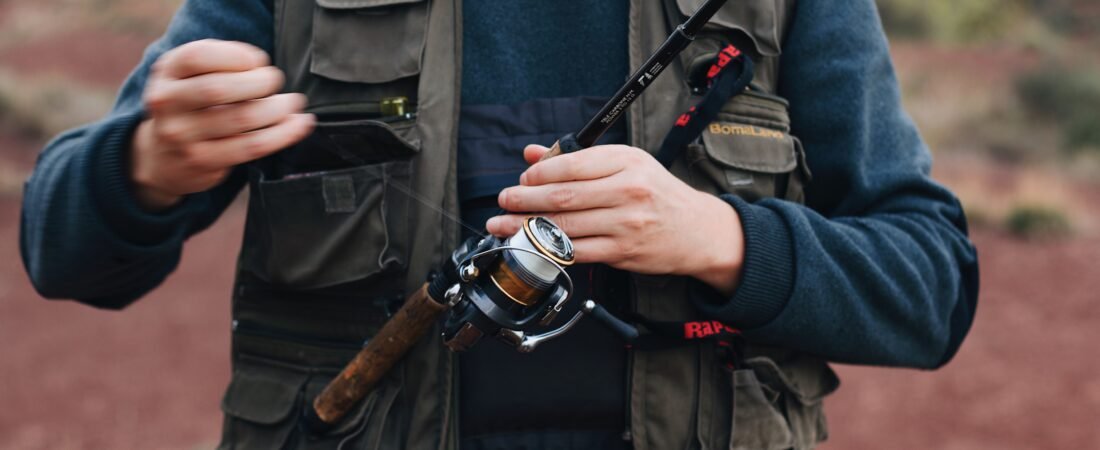
The short answer: for a first fishing line, buy monofilament. It is cheap, forgiving, easy to tie and easy to handle. Add braid later if you fish heavy cover or want more sensitivity, and add a short fluorocarbon leader when the water is clear or the fish are line-shy. No single line is best everywhere, and that is exactly why the choice confuses beginners.
Disclosure: some links on this site may be affiliate links. If you buy through them, we may earn a commission at no extra cost to you.
Quick picks by situation
| If you want… | Start with | Why |
|---|---|---|
| One forgiving all-purpose line for a first rod | Monofilament | Stretch absorbs shock, it ties easily and it costs the least |
| Topwater lures and small plastics around wood | Monofilament | It floats and is soft and forgiving |
| Clear water and cautious fish | Fluorocarbon (often as a leader) | Hard to see underwater |
| Weeds, lily pads and heavy cover | Braid | Almost no stretch and it cuts through vegetation |
| Deep-diving crankbaits | Fluorocarbon | It sinks faster than the other two |
| Maximum sensitivity on a spinning reel | Braid, usually with a fluorocarbon leader | Thin, strong and low stretch |
What each line is, and how it behaves
The three materials are built differently, and almost every difference you feel on the water comes from that construction.
Monofilament
Monofilament is a single strand of nylon. Realtree’s Joe Balog describes it as soft and untwisted, the cheapest of the three and the easiest to tie. Zebco’s gear guide calls it a “go-to option for most anglers” and says its moderate stretch absorbs shock during a fight, which helps beginners. Because it floats, it suits topwater lures, and the Realtree article adds small plastic baits worked around wood cover and use as a shock leader.
The downsides are real. The same stretch that cushions a surge makes hooksets less direct, especially at distance. A floating line is pushed around by wind, and because mono is thick for its strength, it limits how deep a lure can dive. It is also more visible in clear water than fluorocarbon, and it does not cut through heavy vegetation the way braid does. Realtree also notes that mono tends to coil on spinning reels, which is worth remembering when you read the section on spooling below.
Fluorocarbon
Fluorocarbon is made from a single dense resin. According to Realtree, it sinks faster than the other lines, resists abrasion, is hard to see underwater and absorbs less water than mono. Zebco adds that it has very little initial stretch until it nears about 80 percent of its stress limit, and that it has neutral buoyancy, so a lure on it stays suspended in the water column. Zebco lists suspended jerkbaits, plastic worms fished on the bottom and drop shot rigs as good uses, and Realtree adds deep-diving crankbaits and fishing around rocks, barnacles and brush.
The tradeoffs are cost and handling. Realtree says some heavy fluorocarbon leaders cost up to five times as much as mono, that the line is stiff, that it coils badly on spinning reels and that it can be hard to knot above roughly 30-pound test. It can also break on a hard slack-line hookset.
Braided line
Braid is woven from synthetic fibers such as Dyneema or Spectra, per Realtree. It has almost no stretch and a very thin diameter for its strength. The Tackle Room offers a concrete comparison: 20-pound mono is about .018 inch thick, while 20-pound braid is about .009 inch, which is why a spool holds far more braid than mono of the same strength.
Zebco credits braid with sensitivity and reliable hooksets, plus exceptional strength for its diameter, and recommends it for grass, lily pads and dense vegetation. Realtree says it cuts through hydrilla and lily pads and suits flipping, frog fishing, deep water and light-tackle work for strong fish. The cons are that it tangles easily, can wind-knot, can pull hooks free or even straighten them, is visible to fish, and many braids fade over time. Realtree also describes “super” lines, which are coated braids that cast smoothly but feel stiffer.
The sources do not agree on the numbers
If you compare articles, you will notice that the stretch percentages differ. Realtree reports roughly 20 percent stretch for mono in the author’s own test. The Tackle Room lists mono at about 25 to 30 percent, fluorocarbon at about 10 to 15 percent and braid at about 1 to 3 percent. Zebco simply says “moderate” for mono. That is not a contradiction you need to solve. Stretch depends on brand, diameter and how the test is done, so treat the numbers as a ranking rather than a spec: mono stretches the most, fluorocarbon sits in the middle, and braid barely stretches at all.
The Tackle Room also ranks visibility and abrasion resistance. It lists fluorocarbon as the hardest to see and the most abrasion resistant, mono as moderate on both, and braid as the most visible and low to moderate on abrasion. Again, use it as a rough guide. If an article gives you a very exact number without saying how it was measured, be cautious.
Which line works on a spinning reel
Most beginners start on spinning gear, so the practical question is how each line behaves on that reel. The sources split along the lines you would expect.
- Mono is forgiving and easy to manage, according to the Tackle Room, and Realtree calls it comfortable to handle and easy to untangle. It is the lowest-risk first choice.
- Braid is called the strongest choice for spinning reels by the Tackle Room because it casts and handles well. Realtree warns that it can tangle and wind-knot, so it rewards a little care when you reel.
- Fluorocarbon is the odd one out. The Tackle Room says to avoid it as a main line on spinning reels because its stiffness causes coiling and wind knots, and Realtree agrees that it coils badly. As a leader, however, it works fine.
For gear sizes, Take Me Fishing describes a basic spincast setup as a 7-foot rod with 6 to 10 pound line for lures from 1/16 to 3/4 ounce. Sports Illustrated’s Justin Hoffman suggests braid for beginners targeting bass, around 15 pounds on spinning gear and about 50 pounds on baitcasting gear, though that advice is specific to bass fishing around cover. Always stay within the line range printed on the reel spool and the rod blank.
Match the line to the cover and the lure
Think of line as part of the lure presentation rather than a separate purchase. A few pairings that appear across the sources:
- Weeds and lily pads: braid, because it cuts through vegetation and gives solid hooksets.
- Topwater and light plastics near wood: mono, because it floats and forgives.
- Deep-diving crankbaits and rocky or brushy bottoms: fluorocarbon, because it sinks and resists abrasion.
- Clear water with cautious fish: fluorocarbon, because it is hard to see.
- Suspended jerkbaits and drop shot rigs: fluorocarbon, because it holds depth.
None of this is a law. Realtree itself notes that experienced anglers often carry all three lines and choose by technique, cover and budget. If you only buy one spool, buy mono and learn how your reel behaves with it before you branch out.
Leaders: using two lines together
A leader is a shorter length of line tied between your main line and the lure or hook. Realtree and the Tackle Room both describe the most common combination: braid as the main line, with a fluorocarbon leader. That pairs braid’s low stretch and thin diameter with fluorocarbon’s low visibility and abrasion resistance. Mono also works as a shock leader, which can reduce hook pull-outs because it stretches.
The catch is the knot that joins the two. Realtree notes that heavy fluorocarbon is the hardest line to knot, so test your connection before you trust it on the water. If you are not ready to tie line-to-line knots, there is no shame in staying with a single line until you are.
Spool it correctly, or the best line will still tangle
Many beginner line problems are spooling problems. Three sources agree on the basics.
- Check the direction. Outdoor Life’s Alice Jones Webb says mono and fluorocarbon hold the curl of their packaging. Spool so the line leaves the filler spool in the same direction it enters the reel, usually counterclockwise, and flip the spool if you see small loops forming. Game & Fish’s Lee McClelland describes a quick test: reel on a little line, lower the rod toward the filler spool, and if the line jumps and twists, flip the spool over.
- Do not overfill. Outdoor Life says to leave about 1/8 inch of empty space at the spool lip. McClelland says to stop roughly a nickel’s thickness short. Bass pro Michael Iaconelli also recommends at least 1/8 inch. Overfilling makes line jump off in loose coils.
- Add tension and condition the line. Run the line through your fingers under light pressure, and Iaconelli suggests running it through a cloth dampened with line dressing or silicone to remove manufacturing residue.
- Use backing for braid if needed. Outdoor Life says a braid-ready spool can take braid directly, but otherwise add a few layers of mono backing joined with a uni-to-uni knot so braid does not slip.
- Close the bail by hand. Outdoor Life, McClelland and Iaconelli all say that cranking the handle to close the bail, or reeling with the bail open, adds twist that builds over a day.
Also avoid reeling against the drag when a fish runs. Loosen the drag or back-reel instead, per Outdoor Life. And if you ever load line from a store spool, use line that matches the pound-test range printed on your reel.
When to replace your line
Line wears out even when it looks fine. The Tackle Room recommends replacing mono at least every season because sunlight and water weaken it, and says a quality braid can last multiple seasons. Outdoor Life puts it simply: replace line when in doubt, because twist, memory or wear reduce both casting distance and strength. A practical test is to run a few feet through your fingers after each trip. If it feels rough, nicked or weirdly coiled, cut it back or replace it.
Common beginner mistakes
- Buying braid first and expecting it to be easy. It is excellent, but it tangles more readily and punishes sloppy spooling.
- Putting heavy fluorocarbon on a spinning reel as the main line. The stiffness causes coils and wind knots.
- Ignoring knot compatibility. Some knots slip with braid, and Field & Stream warns against using an improved clinch with braid or super line.
- Overfilling the spool because it looks like more line for the money.
- Holding on to old line. Mono and fluorocarbon degrade faster than braid.
Your line-buying checklist
- Pick the line based on your reel type first, then your technique.
- Stay within the pound-test range printed on the spool and rod.
- Start with mono unless you already fish heavy cover.
- Buy a small spool of fluorocarbon leader material if you want to experiment.
- Spool in the right direction and leave a gap at the lip.
- Plan to replace mono at least once a season.
How we researched this
This guide is based on published articles and public information. We have not tested these lines ourselves. We read guides from Zebco (March 2026), Realtree (May 2024), the Tackle Room (January 2025), Outdoor Life, Game & Fish and Bassmaster, and we list each source below. Numbers such as stretch percentages vary by source, so we present them as relative rankings.
FAQ
What is the best fishing line for beginners?
Monofilament is the most common recommendation. Zebco calls it a go-to option for most anglers, and Realtree describes it as forgiving, easy to tie and the least expensive of the three.
Can I use braid on a spinning reel?
Yes. The Tackle Room calls braid the strongest choice for spinning reels. Realtree warns it can tangle and wind-knot, so spool it carefully and close the bail by hand.
Do I need a fluorocarbon leader?
Not always. Fluorocarbon leaders help when water is clear or fish are cautious, and they resist abrasion around rocks and brush. A mono leader can act as a shock absorber instead.
How often should I change my line?
The Tackle Room suggests at least once a season for mono, and says quality braid can last multiple seasons. Replace any line that feels rough or coils badly.