
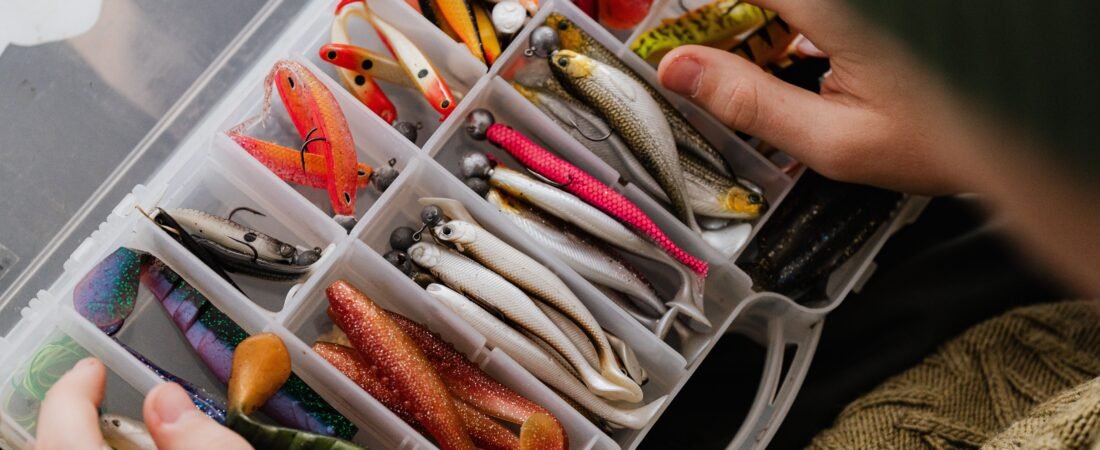
The short answer: most beginner lure advice comes down to a handful of families. Take Me Fishing’s lure guide names plugs, spinnerbaits, jigs with soft plastic, and spoons. FishAnywhere adds crankbaits, soft plastics and poppers. Bassmaster’s Keith Sutton recommends small, shallow-running crankbaits, small spinners and pre-rigged weedless plastic worms for beginners. Learn how each family moves, then buy one or two from the families that match the fish you are after.
Disclosure: some links on this site may be affiliate links. If you buy through them, we may earn a commission at no extra cost to you.
Lure families at a glance
| Lure family | What it is | How sources say to retrieve it |
|---|---|---|
| Plug (hardbait) | Hard plastic lure shaped like a baitfish; floating, suspending or diving | Sharp twitch-and-stop retrieves (Take Me Fishing) |
| Crankbait | Painted body with a plastic or metal lip that makes it dive and wobble | Steady or erratic retrieve (FishAnywhere) |
| Topwater popper | Floats; recessed front section pops the water | Twitched to make pops and splashes (FishAnywhere) |
| Topwater walking bait | Floats; weighted so it zig-zags | Twitched in a zig-zag, known as walking the dog (FishAnywhere) |
| Spinnerbait | Skirted hook on a bracket with a spinning metal blade | Steady, consistent retrieve (Take Me Fishing, FishAnywhere) |
| Jig with soft plastic | Weighted jighead with a soft bait over the hook | Cast, let it sink, lift the rod tip to jig slowly (Take Me Fishing) |
| Spoon | Curved, concave metal lure that wobbles and flashes | Steady retrieve through the target water (Take Me Fishing) |
| Soft plastic | Rubbery baits imitating insects, fish and crustaceans | Depends on how it is rigged |
The big idea: where the lure runs and how it moves
Every lure on the list does two jobs. It runs at a certain depth, and it moves in a certain way. Topwater lures stay on the surface. Crankbaits and plugs with lips dive to a depth set by the lip. Jigs and soft plastics sink to the bottom when you let them. Spinnerbaits and spoons are retrieved through the water, and you choose the depth by how long you let them sink before you start reeling.
Movement matters just as much. Take Me Fishing describes sharp twitch-and-stop retrieves for plugs, a steady retrieve for spinnerbaits and spoons, and a slow lift-and-drop for jigs. FishAnywhere describes a steady or erratic retrieve for crankbaits. The takeaway is that the lure can only do part of the work. The way you retrieve it supplies the rest.
Plugs and crankbaits
Take Me Fishing, in an April 2019 article by Alycia Downs, describes plugs as hard plastic lures patterned to look like baitfish. Topwater versions float on the surface, and suspending versions have a plastic lip. Suspending plugs dive deep or run along the bottom. The article recommends sharp twitch-and-stop retrieves and says topwater plugs attract aggressive fish through noise and movement. It does not name species.
FishAnywhere describes crankbaits as having a painted body with a plastic or metal lip that makes the lure dive and wobble, and says they work for bass in neighborhood ponds and for offshore trolling. It lists a steady or erratic retrieve. The article has no listed author or date.
Bassmaster’s Keith Sutton, in a 2020 article, recommends small, shallow-running crankbaits for beginners, and adds the general rule to use big lures for big fish and small lures for small fish.
Mystery Tackle Box suggests having a couple of hardbaits that cover different depths: a topwater such as a popper or walking bait, a shallow crank or stickbait, and a deep diver. That is a good way to think about it. Rather than buying five similar crankbaits, buy one for each depth band.
Topwater lures
FishAnywhere separates topwater lures into two types. Poppers float and have a recessed front section that pops the water when twitched, creating sounds and splashes. “Walk the dog” lures, also called spooks, float and have weight placed so they zig-zag when twitched.
Sutton gives a useful situation for topwaters: an inactive bass may strike a topwater plug or buzzbait out of annoyance or impulse, even when it ignores a shiner under a bobber. That is one writer’s observation about bass, so treat it as an example of why topwaters exist rather than a guarantee.
Spinnerbaits
Take Me Fishing describes a spinnerbait as a lure with a bright skirt over the hook and a metal blade that spins, reflects light and vibrates, and says it attracts game fish through color and vibration. It recommends a steady, consistent retrieve to move it horizontally through the water. FishAnywhere calls them spinning lures, describes a skirted hook on a bracket with one or more flashy blades, and says they target freshwater species, mainly bass and pike.
The spinnerbait is a good example of a lure where the sources agree. Both describe the same design and the same retrieve. For a beginner, that simplicity is the appeal. You cast, you reel steadily, and the blade does the rest.
Mystery Tackle Box also recommends one or two inline spinners, a related lure, with sizes ranging from panfish-sized to large pike and musky models.
Jigs and soft plastics
Take Me Fishing describes a jig with soft plastic as a weighted jighead on a J-hook, with a soft plastic bait slid over the hook to resemble a baitfish, with different colors and shapes changing how it moves. The retrieve is to cast it and let it sink, then lift the rod tip to jig it slowly. It says to try several techniques to find what works, and notes this lure targets fish near the bottom.
FishAnywhere calls jigs a broad category valued for versatility and casting distance, usable for species from bass to tarpon, fished along the bottom or with a speedier, twitching retrieve. It describes soft plastics as soft, rubbery baits that imitate insects, fish, crustaceans and other prey, in many styles, sizes and colors, used for freshwater species and nearly any inshore saltwater predator.
Sutton recommends pre-rigged weedless plastic worms for beginners, which saves you from learning to rig and from snagging in cover. If you want to go further with soft plastics, our guide to soft plastic rigs for bass explains the common setups.
Spoons
Take Me Fishing describes spoons as curved, concave metal lures that wobble on the retrieve, imitating an injured baitfish, and says to cast and retrieve steadily through the target water column. FishAnywhere describes a curved body that produces fast, flickering movement, imitating fleeing baitfish, and lists fast predatory fish such as mackerel and barracuda as targets, with a quick retrieve.
Here the two sources differ slightly in emphasis. Take Me Fishing says steady, while FishAnywhere says quick. Both describe the same flickering action. The practical read is that speed is something to experiment with, and that fast saltwater predators are the example FishAnywhere uses.
Which three lures should a beginner buy first?
The sources do not agree on a single set, so this is where the differences are useful. This table shows each source’s beginner suggestion.
| Source | Beginner suggestion |
|---|---|
| Bassmaster (Keith Sutton, 2020) | Small shallow-running crankbait, small spinner, pre-rigged weedless plastic worm |
| Take Me Fishing (Alycia Downs, 2019) | Plugs, spinnerbait, jig with soft plastic, spoon (the four it lists) |
| Mystery Tackle Box (2021) | Topwater, shallow crank, deep diver, inline spinner, soft plastics, jigs |
Reading across, a safe starter set is one lure that runs shallow, one that covers the middle of the water column, and one that goes to the bottom. In practice that could be a small crankbait or topwater, a spinnerbait or inline spinner, and a jig with a soft plastic. This is our editorial synthesis of the sources, not a recommendation from any one of them.
Match the lure to the fish and the moment
Sutton’s rule that big lures are for big fish and small lures for small fish is the simplest filter. Mystery Tackle Box gives species examples for soft plastics: tiny tubes and grubs for panfish, ring worms and paddle tails for walleye, and worms, craws and creatures for bass. FishAnywhere says artificial lures suit covering large areas to find active fish, matching prey during feeding frenzies, and making precise casts around structure or vegetation. For when to choose a lure over bait, see our guide to live bait versus artificial lures.
Changing colors and sizes
FishAnywhere says soft plastics come in many presentations, colors and sizes, and Take Me Fishing says different colors and shapes change how a jig moves. None of the sources we read ranks colors, so we do not either. A sensible beginner approach, which is our suggestion and not from the sources, is to carry two or three colors in a style you trust, and to change size or retrieve before you change color.
A practice routine
This section is our editorial suggestion, not from the sources. Pick one lure and one fishing spot and fish it for a full trip. Try a steady retrieve first, then a retrieve with pauses, then a slower one. Note which one gets bumps or follows. Change only one thing at a time so that you learn what the change did. Repeat with a second lure on the next trip.
Common beginner mistakes
- Buying a huge assortment. A few lures from different families cover more than ten similar ones.
- Using one retrieve for everything. Take Me Fishing describes different retrieves for different lures.
- Choosing lures that are too big. Sutton says to match lure size to fish size.
- Ignoring depth. A lure that runs too shallow or deep for where fish are will not get bites.
- Forgetting to check local rules. Hook, barb and lure restrictions exist in some waters, and none of our sources list them.
How we researched this
This guide is based on published articles and public information. We have not fished these lures ourselves. We read Take Me Fishing (April 2019), FishAnywhere (undated), Bassmaster (March 2020, modified February 2022) and Mystery Tackle Box (July 2021). FishAnywhere has no listed author or date, and we use it only for lure descriptions. Where sources differ, such as on spoon retrieve speed, we say so.
FAQ
What is the best lure for a beginner?
Sutton recommends small, shallow-running crankbaits, small spinners and pre-rigged weedless plastic worms. Take Me Fishing describes plugs, spinnerbaits, jigs with soft plastic and spoons as the lures it covers.
What is the difference between a crankbait and a spinnerbait?
A crankbait has a lipped body that dives and wobbles, per FishAnywhere. A spinnerbait has a skirted hook and a spinning metal blade that flashes and vibrates, per Take Me Fishing.
How do I retrieve a topwater lure?
FishAnywhere says poppers are twitched to make pops and splashes, and walk-the-dog baits are twitched in a zig-zag pattern.
Should I use a steady or erratic retrieve?
It depends on the lure. Take Me Fishing recommends steady for spinnerbaits and spoons and twitch-and-stop for plugs. FishAnywhere lists steady or erratic for crankbaits.
Do lure colors matter?
None of the sources we read ranks colors. Take Me Fishing notes colors and shapes change how a soft plastic jig moves.