
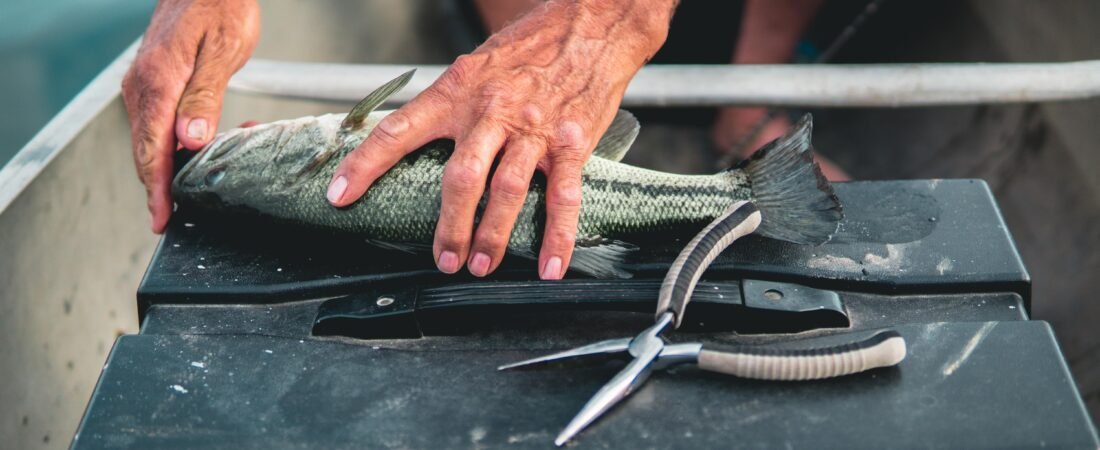
The short answer: this fishing pliers buying guide comes down to five checks: rust-resistant material, sharp cutters, jaws that do not flex, a slim nose that reaches the hook, and a lanyard so they do not sink. The sources split on price, so match the pair to freshwater or saltwater and dry it after every trip.
Disclosure: some links on this site may be affiliate links. If you buy through them, we may earn a commission at no extra cost to you.
In this guide:
- Fishing pliers buying guide: the features at a glance
- What fishing pliers are for
- Materials and corrosion
- The jaw test, the slim nose and the split-ring tip
- Cutters
- Size, reach and type
- Grips, weight, lanyards and storage
- How much should you spend?
- Using pliers to release a fish safely
- Deeply hooked fish: what the sources say
- Care: how to keep pliers working
- A checklist for choosing (our suggestion)
- Common mistakes
- The limits of this advice
- How we researched this
- FAQ
Fishing pliers buying guide: the features at a glance
A good pair has rust-resistant construction, firm jaws, a slim nose, sharp cutters and a way to keep it attached to you. We compared Outdoor Life’s pliers guide by Pete Robbins (July 2021, updated February 2024), Field & Stream’s pliers roundup by Max Inchausti (May 2026), a gear review by Nick Heid on Surf Fishing SoCal SD (October 2022), and Take Me Fishing’s hook removal tips by Debbie Hanson (November 2022).
The table is our summary of what they say.
| Feature | Why it matters | Who mentions it |
|---|---|---|
| Rust-resistant construction | Moisture, and especially salt, damages tools; pliers “rusted shut” fail when you need them | Robbins; Heid; Inchausti |
| Firm jaws | Little or no give when you press the jaws in opposite directions | Heid |
| Slim, longer nose | Reaches the hook in a deeply hooked fish | Heid; Robbins; Inchausti |
| Split-ring tip | A thin profile and extra grip for hook removal and rings | Heid; Robbins (split-ring pliers) |
| Sharp, replaceable cutters | Cut line and wire; a very cheap tool may cut poorly | Robbins; Heid; Inchausti |
| Lanyard or sheath | Keeps the pliers from being dropped overboard and within reach | Robbins; Inchausti; Heid (included accessory) |
Our editorial summary of the table: if a listing does not tell you the material, the cutter type or whether a lanyard or sheath is included, you are guessing on three of the six points.
What fishing pliers are for
Fishing pliers remove hooks, cut line and work split rings, and the best choice depends on what you fish for. Robbins starts with a question: what do you need your pliers to do, and what are you fishing for? Single-function tools are often enough, he says, while a tool that does several jobs typically costs more.
He sorts his picks into premium, budget, long-reach, forceps, split-ring, rigging and braid-scissors categories. He says he still uses split-ring pliers nearly every week to add or replace split rings and treble hooks, and he describes forceps as the tool for delicate fish and fine-wire hooks.
Inchausti makes a related warning: a tool that does many jobs poorly is a worse buy than specialized gear for the jobs you do most. For a beginner who fishes ponds and lakes, the practical starting point is one general-purpose pair with good cutters. You can add specialized tools later.
Utah’s Division of Wildlife Resources, in a beginner equipment article by Darby Doyle, describes pliers as “a tool you use to remove hooks from the fish” and says to have a good set on hand if you plan to release your catch. Our beginner tackle box checklist shows where pliers fit among the other basics.
Materials and corrosion
Titanium resists corrosion best, aluminum is light, and stainless steel sits in between, but none of them is rustproof if you store it wet. Inchausti says titanium has the best corrosion resistance and strength-to-weight ratio but costs more, and that aluminum is lighter and resists corrosion better than steel. Several of his picks use stainless steel.
Robbins notes that moisture “takes a toll on tools” in general, with the effect “particularly pronounced in the salt.” Heid’s reviewed models include stainless steel and anti-corrosion aluminum, and he prizes strong, slim, rust-resistant pliers with sharp cutters.
| Material | What the sources say | Trade-off (our summary) |
|---|---|---|
| Titanium | Best corrosion resistance and strength-to-weight ratio (Inchausti); a premium pick built for salt (Robbins) | Costs more |
| Aluminum | Lighter and resists corrosion better than steel (Inchausti); anti-corrosion aluminum in Heid’s review | Lighter, but check the cutters and jaws |
| Stainless steel | Corrosion resistant, but “will eventually rust” if stored wet (Heid) | Common and widely available |
| Plain or carbon steel | Needs thorough drying and WD-40 on the moving parts (Inchausti) | Cheapest, needs the most care |
Heid adds a detail that goes against a common assumption. He calls his stainless pairs corrosion resistant, but warns that if you store them wet, “they, like all pliers, will eventually rust.”
Robbins tells a similar story: one of his pairs was put away without a rinse and forgotten through the winter, and it later showed corrosion and a tight pivot. A few squirts of WD-40 and a rag fixed it, he says.
Our reading is that material matters, but habit matters just as much. A quick rinse after fishing and a dry-off before storage are free, and they protect any pair.
The jaw test, the slim nose and the split-ring tip
The simplest store test is to press the jaws in opposite directions and feel for give. Heid says there should be very little, if any, give in alignment. A tool that flexes at the jaws is likely to slip when you grip a hook.
He also prefers a slim snout, because the pliers should fit down the mouth and throat of a gut-hooked fish and reach the hook, which matters for catch and release. He says he highly recommends the split-ring version for the thinner profile and extra locking grip.
Inchausti points out that jaw design varies: one pick has a smooth tip with an aggressively cut rear, another uses split-ring-specific jaws, and another has tips that do not fully close, so fly line can catch in them. Heid’s ratings are his own and he describes no testing method beyond the hands-on check, so use his notes as features to look for, not as scores.
Cutters
Cutters are where very cheap pliers fail first, and braid is the hardest test. Robbins says that if a tool is too cheap to make a needed cut, you might as well have bought nothing at all. He notes that the line cutter on one split-ring model does not cut braid, and he lists braid scissors as their own category.
Heid lists tungsten carbide cutters on several models he reviewed, and Inchausti names replaceable cutters on several picks, including tungsten and carbide versions. He also mentions a model with two-position serrated scissors aimed at braid. If you fish with braid, our guide to mono vs fluorocarbon vs braid explains how the line types differ.
Pliers with a good cutter can also trim the tag end after you tie a knot. Our guide to essential fishing knots shows the knots that leave a tag end to trim. That tag-end use is our suggestion, not from the sources.
Size, reach and type
Longer noses reach deeper hooks, and shorter pliers are easier to carry, so pick the length for the fish you target. Inchausti’s picks range from about 4 inches to 8.5 inches, and he says longer-nosed pliers help with deeply hooked fish. Robbins says a standard 6-inch or 8-inch pair sometimes “aren’t up to the task” for a deeply hooked fish, which is why he picks an 11-inch long-reach pair for that job (he aims it at big freshwater fish such as musky and pike).
| Tool type | Sizes mentioned | Best for (our summary) |
|---|---|---|
| General pliers | 6 to 8 in (Robbins) | Hooks, line, light rigging; a sensible first pair |
| Long-reach pliers | 11 in (Robbins) | Toothy or large fish, deeper hooks |
| Forceps | 7 in (Robbins) | Delicate fish and fine-wire hooks |
| Split-ring pliers | About 4 in to 7 in (Inchausti, Robbins) | Lures with split rings and treble hooks |
| Braid scissors | 5.5 in (Robbins’ preference) | Cutting braid cleanly |
Sizes come from the specific models each writer picked, so they are examples, not standards. A beginner fishing ponds will rarely need the 11-inch pair, and a long tool is harder to carry on a belt or in a pocket.
Grips, weight, lanyards and storage
Choose grips you can work one-handed with cold, wet hands, and keep the pliers attached to you. Robbins praises comfortable grips that allow one-handed operation, and one non-slip grip that he finds easy to hold “even when my hands are cold and wet.” He says a pistol grip can help you hang on, whether you have lost some function in your hands or just want maximum grip.
If you are hiking, he says lightweight construction is critical. Size and shape also decide whether the pliers ride in a sheath, a pocket or a spot on your boat, and a designated storage space keeps them ready. Inchausti lists leather, plastic, neoprene and nylon holsters across his picks, and notes that one model has no sheath at all.
Robbins also advises attaching one pair to its lanyard and anchoring it securely, because dropping it overboard “would be tragic,” and he admits to dropping more than one tool over the side of his bass boat. Heid mentions a lanyard and a carabiner as extras on some pairs he reviewed. If you are shopping for a gift, our guide to fishing gift ideas mentions pliers as a practical item, and a lanyard is a small add-on.
How much should you spend?
A budget pair can work for freshwater, but the sources disagree on how far to push a low price. SAIL Magazine’s review team (no individual author, undated, apparently from 2024) says fishing pliers usually cost around $10 to $50 depending on brand and quality. Treat that as a rough range, since prices change.
Robbins says a budget pair is adequate for day-to-day freshwater use, though less durable than pricier models, and that the right tool matters more than the price. Heid is blunter: he rejects buying the cheapest pliers because the inexpensive pairs he tried rusted out every year.
Inchausti describes his picks only in words, from “budget-friendly” to “expensive,” and warns that low-grade tools “rarely did anything well” and often rusted when needed.
These views are not necessarily in conflict. Robbins is talking about freshwater use, and Heid is describing his own experience in salt-heavy surf fishing. In our reading, if you fish freshwater and rinse and dry your tools, a mid-priced pair may be enough. If you fish saltwater, a pair built for it is worth more of your budget. We do not list prices for specific models because they change often.
Using pliers to release a fish safely
Pliers help you unhook a fish quickly, and the agencies we read focus on doing it with the fish kept wet. Hanson’s Take Me Fishing article recommends removing hooks with needle-nose pliers, forceps or a dehooking tool and avoiding jerking or ripping motions, which she says can injure the jaw. She suggests handling the fish in the water or in a rubber landing net.
Texas Parks and Wildlife also lists needle-nose pliers, hemostats or a hook remover. Minnesota’s DNR says to keep pliers ready that work well for removing hooks.
On handling, Texas Parks and Wildlife says to wet your hands, or use a wet rag or glove, before touching the fish, because that protects the slime layer. It says to keep the fish out of the water no longer than you can hold your breath, which is a rough guideline, not a precise number.
NOAA Fisheries says to dehook the fish in the water whenever possible and that less than 60 seconds out of the water is ideal. The U.S. Fish and Wildlife Service says to keep fish underwater as long as you can while removing the hook and to use wet hands or wet rubberized gloves.
Hanson also describes using pliers to crimp barbs: hold the pliers or forceps parallel to the hook point so the barb bends back without weakening the hook. She says single hooks do less damage than trebles. NOAA Fisheries recommends circle hooks, barbless hooks or hooks with crimped barbs, and notes that some fisheries require circle hooks, so check local rules.
Deeply hooked fish: what the sources say
Four of the five sources that address a swallowed hook say to cut the line close to the hook rather than pull it out. Hanson says many fisheries biologists recommend cutting the line close to the hook and leaving it in the fish so it can dissolve. She adds that steel and bronze hooks dissolve more readily than stainless, cadmium-plated or nickel-plated hooks, and that even dissolvable hooks can take weeks or months to break down.
| Source | What it says about a swallowed hook (our summary) |
|---|---|
| Take Me Fishing (Hanson) | Cut the line as close to the hook as possible and leave the hook in |
| U.S. Fish and Wildlife Service | “Do not tear the hook out”; cut the line as close to the mouth as possible |
| NOAA Fisheries | If it cannot be removed easily, cut the line as close to the hook as possible |
| Minnesota DNR | Cutting the line and leaving the hook in is “also a good option” |
| Texas Parks and Wildlife | Links a video for deep-set hooks; no written instruction to cut the line |
So the gap is not a real disagreement: the Texas page is shorter and does not cover that case in writing. If you are unsure, check the current catch-and-release guidance from your state wildlife agency, since recommendations can vary.
Care: how to keep pliers working
Rinse after use, dry fully and oil the pivot if the metal is plain steel. Inchausti says steel pliers need thorough drying and WD-40 on the moving parts, while aluminum and titanium need only a freshwater rinse after saltwater use. That matches Heid’s warning about stainless and Robbins’ story about the forgotten pair.
Our suggestion, not from the sources: open the jaws while they dry so water does not sit in the pivot, and look at the pivot and cutters at the start of each season.
A checklist for choosing (our suggestion)
Use these six checks on any listing or in the store. This section is our editorial suggestion, built from the features above.
- Decide whether you fish freshwater or saltwater.
- Pick rust-resistant construction and sharp cutters.
- Press the jaws in opposite directions to check for give.
- Look for a slim nose, ideally with a split-ring tip.
- Make sure there is a lanyard or a sheath.
- Plan a rinse and dry after each trip.
If you want a pair for each job, add forceps for small hooks, and consider long-reach pliers if deeply hooked fish are common where you fish.
Common mistakes
Most mistakes come from price, storage and handling, not from the tool itself.
- Buying the cheapest pair for saltwater. Heid says the cheap pairs he tried rusted out every year.
- Storing them wet. Heid says even stainless pliers will eventually rust if stored wet.
- Buying one tool for every job. Inchausti warns that a tool that does many jobs can do them poorly.
- Forgetting a lanyard. Robbins says dropping a good pair overboard “would be tragic” and admits to losing tools over the side.
- Ripping a hook out. Hanson says jerking or ripping can injure the jaw, and Texas Parks and Wildlife says to back the hook out the way it went in.
- Handling fish with dry hands. Texas Parks and Wildlife says to wet your hands or use a wet glove.
The limits of this advice
Each source has limits. Heid’s ratings are his own, he does not describe a testing method, and his page includes Amazon affiliate links. Robbins’ guide is broad but dates from 2021 (updated 2024), so models may have changed. Inchausti’s roundup is the most recent, but it gives no prices.
Hanson’s article is about hook removal and does not review pliers. The Texas page and the Minnesota DNR page show no author. NOAA Fisheries and the U.S. Fish and Wildlife Service are agency pages without an individual author, and neither mentions pliers. We found no long-term test data. Pliers can slip, so use them carefully, and check current catch-and-release guidance for your state.
How we researched this
This guide is based on published articles and public information. We have not tested the pliers mentioned or fished with them ourselves. We read Outdoor Life (Pete Robbins, July 27, 2021, updated February 21, 2024), Field & Stream (Max Inchausti, May 25, 2026, modified June 11, 2026), Surf Fishing SoCal SD (Nick Heid, October 16, 2022), Take Me Fishing (Debbie Hanson, November 16, 2022), and SAIL Magazine’s review team (no author or date shown).
We also read Texas Parks and Wildlife’s catch-and-release tips (no author; page metadata shows it created May 2013 and modified September 2022), the U.S. Fish and Wildlife Service first-time angler guide (August 18, 2021, updated September 17, 2024), NOAA Fisheries catch-and-release best practices (page dated 08/04/2026, which we read as August 4, 2026), the Minnesota DNR catch-and-release page (no author; modified March 2018), and the Utah Division of Wildlife Resources beginner equipment guide (Darby Doyle, no date shown). Where sources differ, we say so.
FAQ
What features matter most in fishing pliers?
Rust-resistant construction, sharp cutters, firm jaws and a slim nose are the points the sources stress. Robbins also praises comfortable grips and a lanyard, and Heid recommends a split-ring tip.
How much do fishing pliers cost?
SAIL Magazine puts them at roughly $10 to $50, depending on brand and quality, though that review is undated and prices change. Robbins and Inchausti describe picks only from budget-friendly to expensive.
Do stainless steel pliers rust?
Heid says they will eventually rust if stored wet, like all pliers. Robbins describes a pair stored without a rinse that later corroded and got a tight pivot.
What are pliers used for besides removing hooks?
Robbins says pliers let you modify tackle and cut fishing line, and split-ring pliers handle split rings and treble hooks. Hanson also describes crimping barbs.
Should I cut the line on a deeply hooked fish?
Hanson, the U.S. Fish and Wildlife Service and NOAA Fisheries all say to cut the line close to the hook, and the Minnesota DNR calls it a good option. The Texas Parks and Wildlife page does not address it in writing, so check your state agency’s current guidance.