
The short answer: a beginner tackle box checklist can be short: hooks in a few sizes, split-shot sinkers, bobbers, needle-nose pliers and your fishing license. Three published guides agree on the first three, and two add the last two. Start there, add safety gear, then let the fish you target decide what else to buy.
Disclosure: some links on this site may be affiliate links. If you buy through them, we may earn a commission at no extra cost to you.
In this guide:
- The checklist at a glance
- Start with the box itself
- Tier 1: the essentials
- Tier 2: what to add next
- Tier 3: extras
- Safety and comfort gear
- Organize the box
- How the guides differ
- FAQ
The checklist at a glance
Tier 1 is hooks, split shot, bobbers, pliers and your license; everything else can wait. The table pulls together what Zebco, the Minnesota Department of Natural Resources (DNR) and Mystery Tackle Box list. Tiers are our editorial grouping, not something the sources use.
| Tier | Item | What the sources say |
|---|---|---|
| 1. Essentials | Hooks | Small light wire hooks (Zebco); sizes 6, 8, 10 for stream trout and panfish (Minnesota DNR) |
| 1. Essentials | Split-shot sinkers | Listed by all three; Minnesota DNR recommends nonlead |
| 1. Essentials | Bobbers | Listed by all three; Minnesota DNR suggests fixed and slip types |
| 1. Essentials | Needle-nose pliers | Listed by Minnesota DNR and Mystery Tackle Box; the Almanac also lists pliers |
| 1. Essentials | License and rules | Listed by Minnesota DNR and Mystery Tackle Box |
| 2. Next | Swivels, snap swivels, leaders | Mystery Tackle Box and Minnesota DNR |
| 2. Next | Jigs and soft plastics | Mystery Tackle Box and Minnesota DNR |
| 2. Next | Inline spinners, small crankbait | Mystery Tackle Box and Minnesota DNR |
| 3. Extras | Stringer, ruler, maps, nail clippers | Minnesota DNR; the Almanac also lists a stringer and a ruler |
| Safety | Whistle, first-aid kit, sun protection, water, life vest | Minnesota DNR; the Almanac adds a flashlight and insect repellent |
Start with the box itself
You do not need a large box; a small one with a sturdy handle and a strong latch is enough. The Minnesota DNR’s guide, written for young naturalists, describes a small, top-opening plastic box with one attached tray. That is a useful reminder that the box matters less than what goes in it.
A small box also forces a good habit: you carry what you will use on a given trip and leave the rest at home. If you later outgrow it, you will know exactly why. A second box for lures and a separate bag for bait and tools are common upgrades, but there is no reason to buy that setup before you have fished a few times.
Tier 1: the essentials
Hooks
Buy hooks for the fish you are actually targeting, not a giant assorted pack. Hooks are where the sources give the most specific numbers, and they point in different directions because they are written for different fish. The Minnesota DNR lists sizes 6, 8 and 10 for stream trout and panfish, and sizes 2, 1 and 1/0 for walleye and northern pike. It also lists circle hooks, which it says hook the fish in the mouth without a jerk of the rod.
Mystery Tackle Box, a subscription tackle company, gives a similar split: size 6 or 8 Aberdeen hooks for panfish, and 3/0 or 4/0 offset shank worm hooks for bass. Zebco keeps it simpler and describes small, light wire hooks as a great all-around choice for beginners, and larger, slightly curved octopus hooks for bigger fish or larger baits such as whole nightcrawlers or minnows.
The pattern across the sources is small hooks for small mouths like panfish and trout, and bigger hooks for bass, walleye and pike. The Almanac gives no sizes but says to carry hooks in several sizes so you can match the hook to the fish.
| Target fish | Hook sizes mentioned | Source |
|---|---|---|
| Stream trout and panfish | 6, 8, 10 | Minnesota DNR |
| Panfish | 6 or 8 Aberdeen | Mystery Tackle Box |
| Walleye and northern pike | 2, 1, 1/0 | Minnesota DNR |
| Bass (soft plastic worms) | 3/0 or 4/0 offset shank | Mystery Tackle Box |
| General small hook | Small light wire | Zebco |
Split-shot sinkers, and the lead question
Split shot is on every list, and nontoxic split shot is the safer pick. Zebco describes split-shot sinkers as small round weights that pinch onto the line to sink bait to where the fish are. Mystery Tackle Box lists split shot or sliding sinkers.
The Minnesota DNR recommends nonlead split shot made of steel, tin or other nontoxic material, and says that lead split shot can poison loons and other birds and animals that swallow it. It also says to never put a lead sinker in your mouth.
Rules vary by state and body of water. The American Sportfishing Association’s October 2022 position paper lists examples of state limits on lead sinkers and jigs: New Hampshire (1 oz or less), New York (1/2 oz or less, sales ban), Maine (under 2.5 inches or under 1 oz), Massachusetts (under 1 oz, sales ban), Vermont (1/2 oz or less) and Washington (1.5 inches or less along the longest axis, at select lakes). The same paper says steel is the only alternative priced about like lead, and that tin split shot needs more or larger pieces to match lead’s weight. Those are 2022 examples and rules change, so check your state wildlife agency before you buy.
Bobbers
For a first box, a couple of small round bobbers and one slip bobber cover the advice in the sources. Zebco describes bobbers as floats that clip onto the line and sit on the surface. The Minnesota DNR recommends plastic or foam bobbers in several sizes matched to the weight of your bait, and says to include both fixed bobbers and slip bobbers.
Mystery Tackle Box adds an opinion: it says thin, pencil-style bobbers are more sensitive than traditional round plastic ones. The Minnesota DNR is about having a range, while Mystery Tackle Box is about sensitivity.
Needle-nose pliers
Pliers are the tool to buy first. Needle-nose pliers show up in the Minnesota DNR list of handy gadgets and as number ten of Mystery Tackle Box’s essentials, where they are described as a way to remove hooks safely from panfish and other gamefish. The Almanac adds that pliers also help remove a hook from a person. Fingernail clippers appear in the Minnesota DNR list too, which suits trimming line at the knot.
License and rules
Most states require a fishing license, and the rules vary by state, age and waterbody. Check your state wildlife agency’s website before your first trip.
Both Mystery Tackle Box and the Minnesota DNR put the fishing license on the list. Mystery Tackle Box says a license is required in nearly every state unless you are under 16, and tells readers to review local size and bag limits, permitted methods and species-specific rules. The Minnesota DNR says a license is required for anglers 16 and older and also recommends carrying the state fishing regulations booklet and checking posted signs at docks and boat ramps for lake-specific rules. Treat those ages as examples, because they differ by state.
Tier 2: what to add next
Add swivels and leaders, a few jigs and soft plastics, and one or two lures once you know your target fish. These matter more after your first few trips.
Swivels, snap swivels and leaders
Mystery Tackle Box says swivels help prevent line twist, help tie rigs such as the Carolina rig and the three-way rig, and that some have a snap for quick changes. The Minnesota DNR lists snap swivels and leaders, and says leaders are 6 to 12 inches long and often metal-core.
These matter more once you start fishing toothy fish or using specific rigs, so they are second-tier items for most beginners. If you are tying them yourself, our guide to essential fishing knots covers the knots to learn first.
Jigs and soft plastics
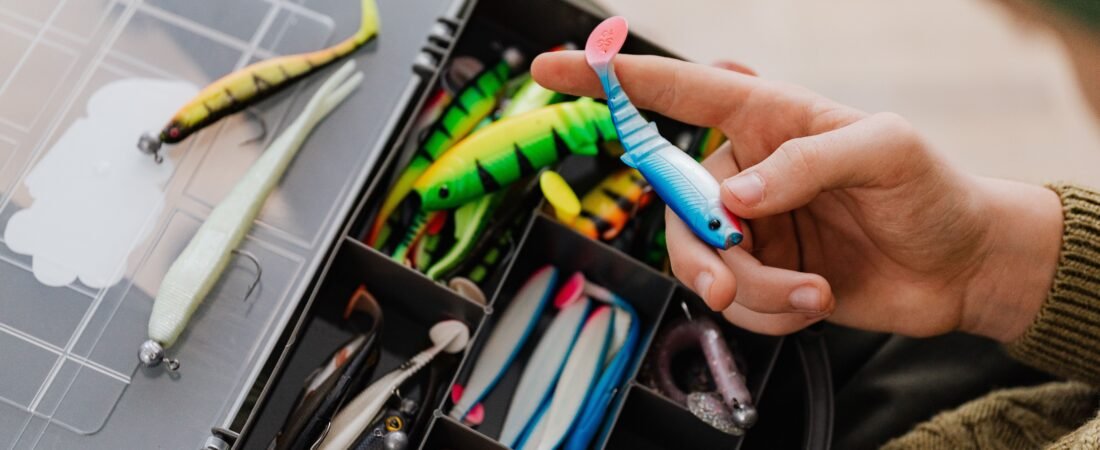
Mystery Tackle Box suggests several jig styles, including ball-head live-bait jigs and skirted bass jigs. For soft plastics it lists tiny tubes and grubs for panfish, ring worms and paddle tails for walleye, and worms, craws and creatures for bass. The Minnesota DNR lists jigs and plastic worms in various shapes and sizes.
Inline spinners and hardbaits
Mystery Tackle Box recommends one or two inline spinners, with sizes ranging from panfish-sized to large models for pike and musky. For hardbaits, it suggests a couple of options at different depths: a topwater such as a popper or walking bait, a shallow crank or stickbait, and a deep diver.
The Minnesota DNR names the same categories in different words: spinners, diving lures such as crankbaits, surface lures such as poppers, and spoons, with a reminder to choose sizes that suit your target fish. Our guide to types of fishing lures explains the families.
You do not need all of these. A better approach is to choose one lure from each category that you plan to use, then expand once you know which ones you are reaching for.
Bait
Live bait does not live in a tackle box, so plan for it separately. If you plan to fish with bait, Zebco calls nightcrawlers and leeches reliable choices, recommends minnows for larger species like bass, walleye and pike, grub worms for panfish like bluegill and crappie, and mentions artificial bait pellets as a mess-free option that it says is especially great for kids. The Minnesota DNR suggests live minnows, leeches or worms, plus bread and whole-kernel canned corn.
Check your state rules on which baits are allowed in the water you are fishing, because they differ. The Almanac adds that you should keep open bait, food and leaking containers out of the tackle box.
Tier 3: extras
Extras are optional but practical, and none of them has to be bought on day one. The Minnesota DNR’s list includes:
- A ruler, for checking fish length limits.
- A stringer.
- Lake or stream maps.
- A practice casting plug.
- A knot-tying card for the improved clinch knot.
- A spare spool of line made for your reel. Our line guide helps you choose.
Mystery Tackle Box says to start with one or two combos, and suggests a decent quality medium action spinning combo spooled with 10-pound monofilament. That is one company’s suggestion for a starting setup. If you are still choosing a reel, our spinning versus baitcasting guide explains the difference, and our best rod and reel combo guide covers complete setups.
Safety and comfort gear
Bring a whistle, a first-aid kit, sun protection, water and a life vest; they matter most if something goes wrong. The Minnesota DNR includes a whistle (it says three blasts is the international distress signal), a first-aid kit, sun protection such as sunscreen, sunglasses and a brimmed hat, drinking water, and a life vest (PFD) worn in a boat or while wading.
The Almanac adds a small flashlight and insect repellent, and says to keep first-aid supplies in a sealed, waterproof bag. Take Me Fishing’s 2025 tackle box refresh article suggests storing bug spray and sunscreen in a separate bag so their smells stay off your lures. Keep the safety kit in a bag next to the box so you do not leave it at home.
Organize the box
Group tackle by target fish, label the trays and keep like items together. Take Me Fishing’s tackle box guide by Debbie Hanson (June 2021) gives six tips: group tackle by target species and label each tray, use adjustable dividers to fit lure sizes, keep soft plastics separated in their original packaging, use small compartments for hooks, weights and floats, keep pliers and line cutters in front pockets or large compartments, and keep spare line in side pockets or a separate bag.
The Almanac (Catherine Boeckmann, September 2026) agrees: keep hooks, sinkers, swivels and lures in separate compartments, keep wet gear out of the box to prevent rust, and replace frayed or brittle line and dull or damaged hooks. Take Me Fishing’s March 2025 refresh article by Andy Whitcomb adds that some soft plastics can melt together or bleed color if stored together, and that you should swap out rusted hooks, split rings, snaps and swivels.
How the guides differ
Most differences are about audience, not disagreement. Reading them side by side shows where the advice comes from.
- Scope. Zebco covers hooks, sinkers, floats and bait only, and sends readers to a separate lures page. The Minnesota DNR covers the full outfitting list including safety. Mystery Tackle Box focuses on ten categories with brand-named examples. The Almanac and Take Me Fishing add checklists and organization.
- Hook sizes. Only the Minnesota DNR and Mystery Tackle Box give size numbers, and they are broadly consistent for panfish (6 to 10) but differ in that the DNR covers walleye and pike while Mystery Tackle Box covers bass.
- Lead. Only the Minnesota DNR and the ASA paper address lead tackle, from different angles: the DNR warns of harm to wildlife and recommends nonlead, while the ASA, an industry group, supports voluntary use of non-lead alternatives and lists state restrictions.
- Bobbers. The Minnesota DNR recommends a range of sizes and types, Mystery Tackle Box prefers thin pencil styles for sensitivity, and Zebco simply describes what they are.
- Commercial interest. Zebco makes fishing tackle and Mystery Tackle Box sells tackle subscriptions, so some product choices reflect what they sell. The Minnesota DNR is a state agency and its guide is educational.
A simple way to build your box
Decide what you will fish for in your first month, then buy only for that fish. This section is our editorial suggestion, not from the sources. Whether that is panfish from a pond, bass from a lake or trout from a stream, buy hooks in the sizes your sources list, a small pack of nontoxic split shot, two bobbers, and pliers. Add one jig, one spinner and one soft plastic style.
Go fishing. After three or four trips, write down what you used, what you lost and what you wished you had. That list is a better shopping list than any article.
Common beginner mistakes
- Buying a huge assortment. A large kit of random hooks, weights and lures fills the box without covering your actual fish.
- Ignoring hook size. A hook that is too large for a bluegill is an easy way to go home with no fish.
- Forgetting the license. The sources that cover it agree a license is required in most cases, so check before you go.
- Overlooking lead. If you use split shot, think about whether a nontoxic version is a better choice, as the Minnesota DNR suggests.
- Leaving safety gear at home. Whistles, first-aid kits, sun protection and water are cheap and light.
How we researched this
This guide is based on published articles and public information. We have not tested the products or items in this checklist ourselves. We read:
- Katie Rojas, Zebco, “Basic Tackle” (April 2026). Zebco makes tackle.
- Roland Sigurdson, Minnesota DNR, “Let’s outfit a tackle box” (2006). It is older and written for Minnesota, so state-specific details are examples only.
- Brett Forde, Mystery Tackle Box, “10 Essentials Every Beginner Fisherman Needs” (July 9, 2021). Mystery Tackle Box sells tackle subscriptions.
- Catherine Boeckmann, The Old Farmer’s Almanac, “What to Put in a Fishing Tackle Box” (September 15, 2026).
- Debbie Hanson, Take Me Fishing, “How to Organize a Tackle Box” (June 15, 2021).
- Andy Whitcomb, Take Me Fishing, “How to Achieve a Tackle Box Refresh” (March 11, 2025).
- American Sportfishing Association, “Position on Lead Fishing Tackle” (approved October 2022).
FAQ
What should be in a beginner tackle box?
Hooks, split-shot sinkers and bobbers, per Zebco, the Minnesota DNR and Mystery Tackle Box. The DNR and Mystery Tackle Box add needle-nose pliers and a fishing license, and also suggest swivels, leaders, jigs, soft plastics, spinners and a few hardbaits.
What hook size should a beginner use?
It depends on the fish. The Minnesota DNR lists sizes 6, 8 and 10 for stream trout and panfish, and sizes 2, 1 and 1/0 for walleye and pike. Mystery Tackle Box suggests size 6 or 8 for panfish and 3/0 or 4/0 offset worm hooks for bass.
Is lead split shot safe to use?
The Minnesota DNR says lead split shot can poison loons and other birds and animals that swallow it, and recommends nonlead split shot made of steel, tin or other nontoxic material. Some states restrict small lead sinkers, so check your state agency.
Do I need a fishing license?
In most states, yes, but the rules vary by state, age and type of water. Check your state wildlife agency’s website for current requirements before you fish.
How do I organize a tackle box?
Take Me Fishing suggests grouping tackle by target fish, labeling trays, keeping soft plastics apart in their original packaging, and storing pliers and line cutters where you can reach them quickly.