
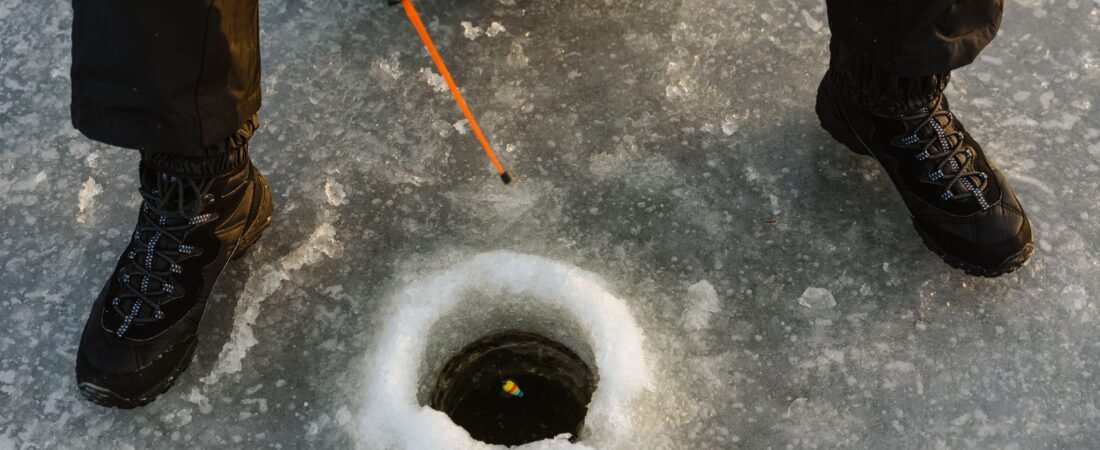
The short answer: ice fishing for beginners starts with safety: you need clear, solid ice, a way to drill and clear a hole, warm layers and self-rescue gear before you think about fish. Sources give different minimum thicknesses, starting around 4 inches for one person on foot, so check your state agency and local conditions first.
Nothing here is safety advice or a guarantee that any ice is safe. Ice varies across a single lake, so this article shows the numbers each source gives and then tells you to check locally.
Disclosure: some links on this site may be affiliate links. If you buy through them, we may earn a commission at no extra cost to you.
In this guide:
- Safety first: ice thickness
- The gear, in tiers
- Rods, reels and line by target fish
- Techniques the guides describe
- Where the fish are, per species
- Licenses, lines and local rules
- A beginner plan
- FAQ
Safety first: what the sources say about ice thickness
Treat 4 inches of new, clear ice as the floor for walking, not a guarantee. The Minnesota Department of Natural Resources (DNR) publishes the best-known thickness chart. Its page, last modified in January 2025, says the guidance assumes new, clear ice, and that you should stay off ice under 4 inches. Here is what it lists:
| Clear ice thickness | What the DNR page says it supports |
|---|---|
| Under 4 inches | Stay off |
| 4 inches | Ice fishing or other activity on foot |
| 5 to 7 inches | Snowmobile or small ATV |
| 7 to 8 inches | Side-by-side ATV |
| 9 to 10 inches | Small car or SUV |
| 11 to 12 inches | Medium SUV or small truck |
The page extends the chart to heavier vehicles, but a beginner walking out with a sled will not need those rows. It also includes a second table for stationary loads, which it says comes from an Alberta government publication rather than the DNR, and which lists 6 inches for a person standing and 10 inches for a snowmobile.
Now compare that with the other sources:
- Bass Pro Shops’ 1Source guide says solo anglers should confirm about 4 inches of ice and groups should aim for 6 inches.
- Lake.com’s guide says to use at least 4 inches of solid, clear ice for walking, and that larger groups or vehicles need thicker ice.
- FishUSA’s January 2026 guide says at least 4 inches for one person on foot, roughly 5 to 7 inches for small groups or light ATVs, and 8 to 12 or more inches for snowmobiles and light vehicles. That is thicker than the DNR’s snowmobile row, which is a reminder that guides differ.
- Cast and Spear’s gear guide gives no numeric thresholds. It tells readers to check their state DNR’s ice guidance.
- Maine’s Department of Inland Fisheries and Wildlife also gives no number. It tells anglers to drill several test holes, because ice varies across a water body.
So the sources agree on 4 inches as the floor for a person on foot, but the Minnesota DNR’s stationary table lists 6 inches for a person standing. The difference reflects different tables and assumptions, not a firm rule. The consistent message is that these are minimums for clear ice, and that you should not treat any number as a guarantee.
Things that make the number unreliable
A thickness chart is only a starting point. The Minnesota DNR page lists several reasons:
- White ice is weaker. Snow that melts and refreezes forms white ice, which the DNR says is roughly half as strong as new, clear ice, and it says to double the thickness guidelines when traveling on white ice.
- Thickness varies. The DNR says ice is seldom the same thickness over a single body of water, and Lake.com agrees, advising you to check at regular intervals with a tape measure.
- Moving water and narrow areas. The DNR says currents, springs, streams and bottlenecks affect ice strength. Bass Pro’s guide also tells readers to avoid cracks, moving water and newly formed ice, and Maine’s guide names rock piles, inlets and outlets as places where ice is often thinner.
- The agency does not measure it for you. The DNR states that it does not measure ice thickness on Minnesota lakes and that your safety is your responsibility.
Bassmaster’s first-timer guide by David A. Brown adds a practical point: do not rely only on thickness. Ask local plow crews, bait shops or guides about conditions, and be cautious of slush. FishUSA says to test with a spud bar and drilled test holes, and adds “When in doubt, back out.”
Lake.com quotes Louis Porter, the Vermont Fish & Wildlife commissioner, saying that once sustained cold weather has formed good ice, ice fishing can be safe and a lot of fun. The word “once” is doing real work in that sentence, and it is why checking conditions is part of the activity.
Self-rescue and basic safety gear
Every gear guide we read includes safety equipment:
- Bass Pro says to keep personal flotation devices, ice picks and throw ropes within quick reach.
- Lake.com says to tell someone your trip details, carry ice picks, wear a life jacket and monitor the weather. It also lists a safety kit with waterproof matches, a whistle, warm blankets and first-aid supplies.
- Cast and Spear lists a kit with retractable ice picks worn on the jacket, a whistle and ice creepers. It adds that ice picks are for self-rescue after a fall through the ice, not for testing ice, and that self-rescue gear does not replace checking ice thickness before walking out.
- FishUSA lists ice picks, a float suit or PFD, a throw rope of 25 to 50 feet, a spud bar and ice cleats, and says not to go out alone on early or late ice.
That last distinction is worth repeating. Picks help after something has gone wrong. Thickness checks are what you do to avoid it. Maine’s guide also says to tell someone your location and return time.
The gear, in tiers
You need an auger, a skimmer, a short rod, warm layers and safety gear first; shelters and tip-ups can wait. The tiers below are our editorial grouping of items the sources mention.
| Tier | Item | What the sources say |
|---|---|---|
| Must have | Ice auger | Hand augers are affordable and lightweight; gas and electric drill faster but cost more (Bass Pro) |
| Must have | Skimmer | Clears ice and slush from the hole (Bass Pro, Lake.com) |
| Must have | Short rod and ice line | Start with an affordable combo (Bass Pro) |
| Must have | Warm clothing | Layers: wicking base, insulating mid-layer, waterproof shell (Bass Pro, FishUSA) |
| Must have | Safety gear | Picks, flotation, whistle, ropes (all guides) |
| Useful | Spud bar or chisel | Tests ice ahead of you (FishUSA); Maine says a chisel is best early in the season |
| Useful | Bucket or seat | Keeps you off the ice and holds gear (Cast and Spear) |
| Useful | Sled | Hauls gear across the ice (Bass Pro) |
| Useful | Ice cleats | Traction on slick ice (Bass Pro, Maine DIFW) |
| Later | Shelter | Sizes and features vary widely (Bass Pro) |
| Later | Tip-ups | Flag-signaled devices that let you fish several holes (Bass Pro) |
| Later | Heater, electronics | Bass Pro lists a portable heater; Lake.com lists fish finders and cameras as optional |
Augers
For a beginner who plans to drill a handful of holes, a hand auger is the entry point the sources describe. Bass Pro says hand augers are affordable and lightweight, and suited to thinner ice and a few holes, while gas and electric augers drill faster but cost more to buy and fuel.
Lake.com says manual augers are quiet and budget-friendly and power augers are faster, and that holes are typically 8 to 10 inches in diameter. Cast and Spear’s list starts with an 8-inch hand auger. Maine’s guide suggests borrowing a powered auger from friends before buying one.
Clothing
Dress in three layers and keep your hands and feet dry. Bass Pro recommends a moisture-wicking base, an insulating mid-layer and a waterproof shell, plus warm socks, gloves, a hat and insulated boots.
Lake.com agrees on insulated boots, an all-weather suit, and thermal hat and gloves, and says to stay dry to avoid hypothermia. Bassmaster adds that kneeling on damp ice speeds up hypothermia. Lake.com also mentions that battery-powered heaters avoid fume risks in shelters, and FishUSA says propane heaters need ventilation. We are not giving medical advice here, only repeating what the guides say.
Shelters and tip-ups
Shelters and tip-ups are later purchases for most beginners, since a bucket seat and good clothing cover the basics. Bass Pro describes a shelter as protection from the elements and a comfortable fishing space, with sizes and features that vary widely. Lake.com mentions portable shelters that can be towed on a sled, and permanent wood or metal huts.
A tip-up, according to Bass Pro, is a flag-signaled device that alerts you to a bite so you can fish several holes at once. Check your state’s rules on how many lines you can use, because that varies.
Rods, reels and line by target fish
Ice rods are short, roughly 24 to 32 inches, and line gets heavier as the fish gets bigger. Lake.com says ice rods are shorter, with sensitive tips and a sturdy build, and Bassmaster notes you do not need to cast through a hole. Bass Pro says to start with an affordable basic rod-and-reel combo and ice fishing line.
| Target | Rod and reel | Line |
|---|---|---|
| Panfish | Ultralight rod, 24 to 28 in; small spinning reel, size 500 to 1000 (FishUSA, Bassmaster) | 2 to 4 lb (3 to 4 lb per FishUSA) |
| Walleye | Medium-light rod, 28 to 32 in (FishUSA) | 6 to 8 lb, with a 6 lb fluorocarbon leader (FishUSA) |
| Trout and pike | Medium-light rod, 28 to 32 in (FishUSA) | 8 to 12 lb (FishUSA) |
| Larger fish, braid setup | Medium or medium-light rod (Bassmaster) | 10 lb braid with a 10 to 12 lb fluorocarbon leader (Bassmaster) |
Bassmaster gives a general rod length of 25 to 30 inches, while FishUSA splits it by target. Both agree on short rods and light line for panfish.
Cast and Spear’s list includes a 26-inch light-action spinning ice combo, a braided ice line in 15-pound test, an 8-pound monofilament and a 5-pound fluorocarbon ice line, and says to match line weight to the fish you expect and the size of your hole. It notes that lighter line suits small fish and finesse presentations, while heavier line handles bigger fish. Lake.com adds that braided line suits big predators.
If you want a refresher on how those line types differ, see our guide to monofilament, fluorocarbon and braid.
Techniques the guides describe
Most beginners start by jigging a small lure just above the bottom, or by setting a tip-up with live bait. Pick one method and learn it before mixing several.
Jigging
Lake.com describes jigging as short, sharp rod lifts. Bass Pro describes it as an up-and-down lure motion and says to practice to find what works for your target fish. FishUSA gives a number: lift the rod tip 2 to 4 inches.
Lake.com adds that in extreme cold, subtle jigging works better because fish are less active, and that changing lure motion to mimic injured prey can help. Bassmaster suggests trying flashy, noisy lures to attract fish, then switching to a subtle jig and maggot combo to get bites. For lure basics, see our guide to types of fishing lures.
Tip-ups
Lake.com describes tip-ups as devices where a flag signals a bite. They are used with live bait such as big shiners or suckers for pike, according to the same article. Maine’s guide suggests setting a few traps “just under the ice,” a foot or two below it, and checking bait hourly.
Mapping your holes
Lake.com recommends a grid pattern: drill holes at varied depths and distances and track productive spots. FishUSA suggests moving to a new hole after 15 to 20 minutes without a bite or a fish on sonar.
Lake.com also quotes Dalius Rakutis advising anglers not to jump from one technique to another, because it is better to master one and go from there.
Where the fish are, per species
Look for structure and depth changes: shallow weedy areas for panfish, drop-offs and weed lines for bigger predators. Lake.com gives a species-by-species summary that is useful as a starting point, though it is one source and conditions vary:
| Fish | Where Lake.com says to look | Bait mentioned |
|---|---|---|
| Panfish, yellow perch, crappie | Usually shallower water near structure | Wax worms and small minnows, with tiny jigs |
| Rainbow, brook and lake trout | Varies by depth; lake trout may be as deep as 40 feet | Not specified |
| Landlocked salmon | The first 15 feet below the ice can be productive | Smelts or similar legal baitfish |
| Walleye | Weed beds, drop-offs, depth changes; may be more active in low light | Live minnows or baitfish-mimicking lures |
| Northern pike and muskie | Weed lines and drop-offs | Big shiners or suckers under a tip-up |
More generally, the article suggests targeting lakes, ponds and reservoirs with deep areas, drop-offs and submerged structure such as rocks and fallen trees, fishing where current slows in rivers, and checking weed beds.
Other guides line up. FishUSA puts panfish on weed edges in 6 to 15 feet of water. Maine’s guide says most target species there can be caught in 15 feet of water or less near shore, around rocky shorelines, points and islands, and suggests starting with yellow perch, largemouth bass and pickerel, which often bite quickly. Bassmaster points to mid-lake structure such as rocks, weed lines or mud flats, and says topographic charts help.
Time of day matters too, as with open-water fishing; see our guide to the best time and weather to fish.
Licenses, lines and local rules
Most states require a fishing license, and the rules vary by state, age and waterbody. Check your state wildlife agency’s website before your first trip.
Rules on the number of lines and live bait vary too. As one example, Maine’s Department of Inland Fisheries and Wildlife says you may have five lines set at once in most Maine waters, counting traps and jigging combined, that some waters prohibit live bait, and that children under 16 do not need a license. The page has no date, so check the current rules for your own water.
Etiquette
Give other anglers space, keep noise down and pack out your trash, according to FishUSA. Maine’s guide adds never to dump bait into the water or down the hole. FishUSA also suggests keeping harvests modest and considering releasing large fish.
Timing: ice fishing is a pre-season project
Buy and test gear before the ice forms, and learn the safety basics while the lake is still open. Publication dates matter for this topic. Bass Pro’s guide was updated in April 2026, FishUSA’s was published in January 2026 and Cast and Spear’s was updated in late September 2026, which suggests that gear guides get refreshed around the season. This paragraph is our editorial observation, not from the sources.
A beginner plan
Go the first time with someone who knows the lake, keep the trip short and fish one rod with one technique. This section is our editorial suggestion, not from the sources.
Choose a small, familiar body of water. Bring the safety kit, check thickness with a tape measure or auger at intervals, and tell someone where you are going. Leave if the weather turns. You will learn more from a successful, uneventful trip than from an ambitious one.
Common beginner mistakes
Most mistakes involve trusting a single number or skipping local checks.
- Treating one number as a guarantee. Thickness varies across a lake, and white ice is weaker.
- Using ice picks to test ice. Cast and Spear says they are for self-rescue.
- Buying a shelter before a seat and warm clothing.
- Not checking local rules. Line limits, bait and licenses vary by state.
- Going alone and not telling anyone. Lake.com and Maine’s guide say to share your trip details.
How we researched this
This guide is based on published articles and public information. We have not been on the ice with this gear, and we do not measure ice. Thickness figures are quoted from the sources as they state them, with their assumptions, and are not safety advice. Check your state agency for current conditions and rules. We read:
- Minnesota DNR, “Ice thickness guidelines” (last modified January 28, 2025).
- Maine Department of Inland Fisheries and Wildlife, “A Beginner’s Guide to Ice Fishing in Maine” (undated; copyright 2026).
- David A. Brown, Bassmaster, “Ice fishing tips for first-timers” (December 18, 2023).
- FishUSA Staff, “Tips for Beginner Ice Anglers: Start Safe, Stay Warm, Catch Fish” (January 22, 2026). FishUSA is a tackle retailer.
- Bass Pro Shops 1Source, “Ice Fishing 101” (October 30, 2023, updated April 3, 2026).
- Jon Stenstrom, Cast and Spear, “Your Beginner Ice Fishing Gear Guide for 2026” (September 6, 2019, updated September 29, 2026).
- David Ciccarelli, Lake.com, “Ice Fishing Guide: Essential Gear, Safety Tips, and Techniques” (October 21, 2025, updated May 3, 2026).
FAQ
How thick should ice be for ice fishing?
The Minnesota DNR lists 4 inches of new, clear ice for activity on foot. Bass Pro says solo anglers should confirm about 4 inches and groups should aim for 6. These are minimums for clear ice, not guarantees.
Is white ice safe?
The Minnesota DNR says white ice is roughly half as strong as new, clear ice and advises doubling the thickness guidelines.
What do I need to start ice fishing?
The guides list an auger, a skimmer, a short rod with ice line, warm layered clothing, and safety gear such as ice picks and a flotation device. Shelters and tip-ups can come later.
Should I use ice picks to test the ice?
No. Cast and Spear says ice picks are for self-rescue after a fall through the ice and do not replace checking thickness before walking out.
Do I need a license to ice fish?
In most states, yes, but the rules vary by state, age and type of water. Check your state wildlife agency’s website for current requirements before you fish.