
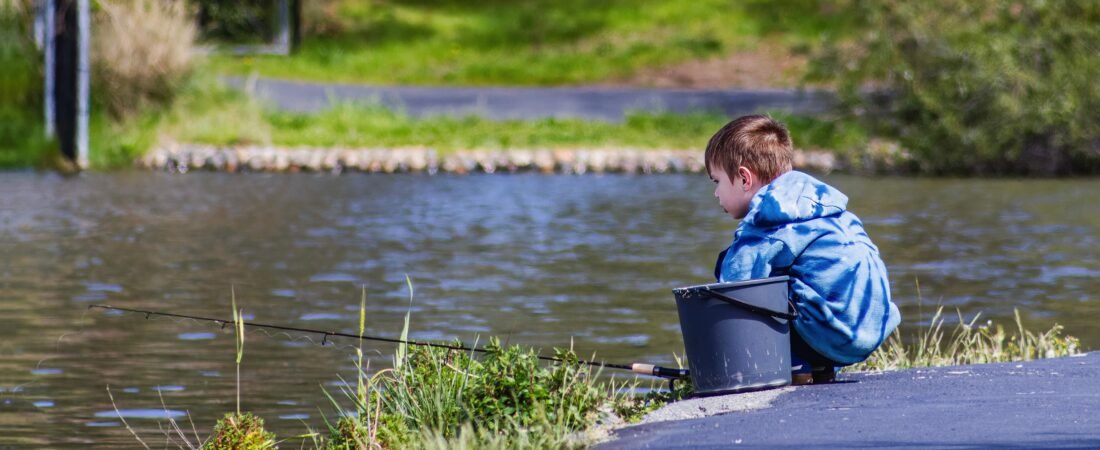
The short answer: for a kids fishing rod and reel, choose a reel the child can work without tangles, a rod that fits the child’s size, and light monofilament line that comes already on the reel. The sources favor push-button spincast reels for ages 4 to 6 and spinning reels later, with rods from about 3 to 6 feet.
Disclosure: some links on this site may be affiliate links. If you buy through them, we may earn a commission at no extra cost to you.
In this guide:
- What the sources say at a glance
- Kids fishing rod and reel: spincast or spinning?
- Reel quality: what to check
- Rod length and size
- Line
- A simple first-trip setup
- What a kids fishing rod and reel costs
- Safety and supervision
- Practice before the trip
- A way to choose (our suggestion)
- Common mistakes
- The limits of this advice
- How we researched this
- FAQ
What the sources say at a glance
The sources agree on light monofilament line, and they disagree on reel type and rod length. We compared three beginner guides: a Take Me Fishing article by Debbie Hanson (October 2022), a Nebraskaland Magazine piece by Daryl Bauer (April 2020), and a Midwest Outdoors article credited to Geremy Olson (May 2018).
Bauer is a fisheries biologist with the Nebraska Game and Parks Commission. All three guides are aimed at beginners. The table is our summary of where each lands.
| Choice | Take Me Fishing (2022) | Nebraskaland (2020) | Midwest Outdoors (2018) |
|---|---|---|---|
| Reel type | Closed-face spincast for ages 4 to 6; open-face spinning for kids over 7 or saltwater | Push-button spincast combo | Spinning preferred; spincast is easy to learn but often bulky for small hands |
| Rod length | No-tangle rods are usually about 3 to 4 feet | Up to 6 feet works; the author’s own is 5.5 feet | About 1 to 1.5 feet longer than the child, until about 5 feet tall |
| Line | Combos typically pre-spooled with 6 lb test | 6 or 8 lb monofilament | Inexpensive monofilament, typically 6 to 10 lb |
| Buying advice | Look for durable parts such as all-metal gears | Buy a combo; cheap character-themed combos often do not last | Spend enough to last at least one season, not so much that a broken rod causes frustration |
Table: our editorial summary of the three sources named in the header row.
None of these is a lab test. They are experienced anglers sharing what has worked. Olson says he does not have hard numbers for his durability rule of thumb, which is why we point out disagreements instead of hiding them.
Kids fishing rod and reel: spincast or spinning?
For the youngest children, most sources point to a push-button spincast reel, and spinning reels come later. A spincast reel is closed-face: you press the button, swing the rod and release the button to let the line go. A spinning reel is open-faced: you flip the bail and hold the line with a finger before you cast.
Take Me Fishing recommends closed-face spincast reels for ages 4 to 6 because of their “simple push-button designs.” It suggests open-face spinning reels for kids over 7, and also for saltwater, because they are easier to rinse and clean and have fewer places for saltwater to cause mechanical problems.
The Utah Division of Wildlife Resources (author Darby Doyle, no date shown) calls a spin casting combo “the best choice for a kid’s first fishing rod” and “very easy to use.” The Minnesota DNR (no author, page modified February 2026) calls the spin-cast reel the simplest to use and says spinning reels are popular but harder to handle.
Olson takes the other side. He says spincast reels are often considered the easiest to learn with, but most are bulky for small hands, and he prefers spinning reels as the more durable option.
He also describes using a baitcasting reel for small kids in a boat, with the rod in a holder. That is his own experience, and we would not treat it as a standard first-reel recommendation.
| Spincast (closed-face) | Spinning (open-face) | |
|---|---|---|
| Typical age in the sources | About 4 to 6 (Take Me Fishing); very young children (Downs, 2019) | Over 7 (Take Me Fishing); pre-teens as a transition setup (Downs, 2019) |
| How it works | Push button to cast; line is covered | Flip the bail and hold the line with a finger |
| Ease | Called simplest to use (Minnesota DNR, Utah DWR) | Called harder to handle (Minnesota DNR); preferred for durability by Olson |
| Saltwater | Take Me Fishing suggests open-face spinning for saltwater instead | Easier to rinse and clean (Take Me Fishing) |
Table: our editorial summary of the sources named.
Our reading is that the disagreement is mostly about age and hand size, not about a right answer. A younger child who has never cast anything is likely to do better with a push-button reel. An older child, or one with larger hands, may be ready for spinning.
If you want to see how the two compare for adults, our guide to spinning vs baitcasting reels explains the mechanisms.
Reel quality: what to check
Check the parts you can see: metal gears, a non-slip grip and a build that does not tangle. Hanson gives the most concrete advice. She says to look for durable parts such as all-metal gears, because cheap mechanisms cause tangles that she calls “bird’s nests.”
She also describes no-tangle rods, which run the line inside the rod shaft instead of through exterior guides. They are usually about 3 to 4 feet long, sold as spincast combos, and meant to be durable yet sensitive enough to feel light bites.
Hanson recommends non-slip grips sized for smaller hands and lightweight materials such as graphite, fiberglass or composite blends. Her article gives no price or size guidance beyond the rod length, so these checks are about build, not budget.
Rod length and size
Rod length is where the sources differ most, so match the rod to the child’s size and strength rather than to one number. The table lists what each source says.
| Source | What it says about rod length |
|---|---|
| Take Me Fishing, Hanson (2022) | No-tangle rods are usually about 3 to 4 feet |
| Utah DWR (undated) | Kids’ models can be as short as 2 to 3 feet; typical rods run 5 to 8 feet |
| Take Me Fishing, Downs (2019) | A small five-foot spincast combo for very young children |
| Minnesota DNR (2026) | Lists a 5-foot youth pole and a 2.5-foot beginner pole |
| Nebraskaland, Bauer (2020) | Up to 6 feet works; his own is 5.5 feet |
| Midwest Outdoors, Olson (2018) | About 1 to 1.5 feet longer than the child, until about 5 feet tall |
| Bass Pro Shops, Wilson (2012, updated 2013) | Roughly the child’s height |
Table: our editorial summary of the sources named.
As simple arithmetic, a child who is 4 feet tall would use a rod of about 5 to 5.5 feet under Olson’s rule. These numbers conflict less than they look. Hanson describes compact combos for the youngest children, while Bauer and Olson describe beginner outfits for older or bigger kids.
Olson adds a reason for the longer rod: it keeps hooks farther from the angler. He also warns that very short rods are hard to cast and can leave an adult casting for the child. Bass Pro’s older article says to pick a rod with some stiffness so it is not whippy.
Olson also suggests a fast-action rod in medium to medium-heavy power for general beginners and cautions against very flimsy slow-action rods. A child’s rod will be smaller, so treat that as a warning about limp rods rather than a spec to match.
Line
Light monofilament in the 6 to 10 pound range is the common answer, and many combos already come with it. Hanson says kid combos typically come pre-spooled with 6 pound test. Bauer recommends 6 or 8 pound mono and calls it a good all-around line for a starter outfit.
Olson suggests inexpensive mono in the 6 to 10 pound range because it is easy to tie, cheap to replace and gentler on hands around snags. The Minnesota DNR calls 8-pound test a good all-purpose line. The U.S. Fish and Wildlife Service’s freshwater checklist lists 4 to 12 pound monofilament.
The Utah DWR says line strength should roughly match the weight of the fish you are after, and that ultra-light rods use 4 to 8 pound line, which suits panfish. Bass Pro’s 2012 article suggests braided line, which the other sources do not, so we left it out as a beginner default.
If the combo comes spooled in that range, you can leave it. To compare line types later, see our guide to mono vs fluorocarbon vs braid.
A simple first-trip setup
Keep the end of the line simple: a small float, a light jig head and a bait kids can handle. Bauer’s article is the most specific, and it is aimed at bluegill and other panfish near shore. He recommends small floats sized to float the bait, and says oversized bobbers are a common mistake because small bites go unseen.
He suggests starting with the float about two feet above the jig head, then adjusting, and says to “let the fish tell you what they want.” For terminal tackle he skips split shot and multiple hooks and uses 1/32 or 1/64 ounce jig heads, painted or unpainted.
His bait list includes small pieces of nightcrawler, red wrigglers, small leeches, crayfish tail meat, scented soft baits, small soft plastics and wax worms. This is one author’s regional method for one kind of fishing, so line weight and target species may need adjusting elsewhere.
Bass Pro’s older article also points to small round bobbers, earthworms as live bait and small hooks for panfish. It suggests crushing the barb with needle-nose pliers to make hook removal easier on the fish. Check your state’s lead rules before using sinkers.
What a kids fishing rod and reel costs
A child’s first outfit does not need to be expensive, and several sources say not to spend much until the child is committed. The Minnesota DNR’s equipment page lists example prices from its own program: a youth pole (5 feet) at $15, a beginner pole (2.5 feet) at $13, and basic tackle (bobber, sinker, hook) at about $5.
Those are Minnesota examples, not national prices. Hanson’s article gives no price guidance, and we do not list retail prices because they change often. Compare a few combos against the build checks above and check the current listing.
Downs (Take Me Fishing, September 2019) says fishing gear can be an expensive investment, and suggests waiting until a child is committed before buying higher-quality equipment. Olson says to spend enough for gear that lasts at least one season, because kids grow quickly, but not so much that a broken rod causes frustration.
Bauer advises against cheap character-themed combos that he says will not last, though he concedes one is fine if it gets a child started. The USFWS adds that some libraries, state agencies, hatcheries and wildlife refuges offer tackle loaner programs for families and beginners, so call local sites first.
Most states require a fishing license, and the rules vary by state, age and waterbody. Check your state wildlife agency’s website before your first trip.
Safety and supervision
Keep children within arm’s reach, put a life jacket on them near water and use a gentle bank.
Bass Pro Shops’ 1Source (updated April 2026) suggests a life jacket even on shore or on a dock, a spot without steep drop-offs, piers with railings, and keeping the child within arm’s reach. It is retailer content, so we use it for the ideas only.
The USFWS says to fish with a companion who can help in an emergency, and to wear a Coast Guard-approved personal flotation device or life vest when wading or in a boat. Hooks need care too. Bauer says the light jig heads make hook removal easy, and that forceps may help remove one.
Bauer also encourages releasing fish, and says the big panfish should always go back. Keep only fish of legal size for a meal, and check your state’s current regulations before keeping any fish. This is general information, not safety advice.
Practice before the trip
A few minutes of practice at home makes the first trip less frustrating. Bass Pro’s older article suggests practicing casting in the backyard with a weighted washer tied to the line instead of a hook. It is a 2012 article, so we use it as a general idea.
Our guide on how to cast a spinning reel walks through the motion you would teach an older child. For a younger child on a push-button reel, the same pattern applies: slow swing, release the button at the top, and keep a safe distance from others.
A way to choose (our suggestion)
Start with the child, not the product. This section is our editorial suggestion, not from the sources. If the child is young and has never cast, a push-button spincast combo with a short, durable rod is the option most sources point toward.
If the child is older, taller or has used a push-button reel, a spinning combo is a reasonable next step, which is the direction of Hanson’s age 7 guideline and Olson’s preference. When you can, let the child hold the rod and work the reel before you buy, and watch whether the grip fits their hand.
If you are buying online, check the return policy.
Common mistakes
Most mistakes come from the wrong size, the wrong tackle or too much too soon.
- Buying a rod that is too long or too short. Olson warns that very short rods are hard to cast. Match the rod to the child’s size.
- Choosing a reel that tangles. Hanson says cheap mechanisms cause bird’s nests. Look for durable parts.
- Using an oversized bobber. Bauer says small bites go unseen.
- Using heavy line. The sources point to 6 to 10 pound mono for panfish-style fishing.
- Trusting a cheap character combo. Bauer says they often do not last.
- Skipping supervision. Keep the child within arm’s reach near water.
The limits of this advice
The sources are useful but narrow, so treat the numbers as ranges. Hanson’s article is aimed at young anglers catching small fish such as bluegill and sunfish, and gives no guidance on rod action, power or line weight beyond the 6 pound default. Her age ranges are general guidelines.
Bauer’s piece is from 2020 and focused on Nebraska waters. Olson’s 2018 article is anecdotal and gives no brands or prices. The Utah DWR page shows no date, and the Minnesota prices are one state’s examples. Bass Pro’s gear article is from 2012 and from a retailer.
How we researched this
This guide is based on published articles and public information. We have not tested these combos or taught a child to fish ourselves. We read the following, and details may change:
- Debbie Hanson, Take Me Fishing, “How to Choose the Best Kids Fishing Rod” (October 13, 2022).
- Daryl Bauer, Nebraskaland Magazine, “Kid’s Fishing System” (April 1, 2020).
- Geremy Olson, Midwest Outdoors, “Picking the Right Rod for Beginner Anglers” (May 2018).
- Alycia Downs, Take Me Fishing, “Kids Fishing Poles: What to Know Before You Buy” (September 5, 2019).
- Utah Division of Wildlife Resources, “Learn to fish: basic equipment” (Darby Doyle, no date shown).
- Minnesota DNR, “Fishing Equipment” (no author shown, page modified February 25, 2026).
- U.S. Fish and Wildlife Service, “Responsible Fishing Tips for New Anglers” (August 18, 2021, updated September 17, 2024).
- Bass Pro Shops 1Source, “6 Tips for Introducing New Kid Anglers to Bank Fishing” (May 23, 2019, updated April 3, 2026), and Keith Wilson, “Taking Kids Fishing, Part 3” (October 17, 2012, updated August 5, 2013).
Bass Pro Shops is a retailer, so we use it for general ideas, not product recommendations. Where the sources disagree, we say so.
FAQ
What kind of reel is best for a young child?
Take Me Fishing recommends closed-face spincast reels for ages 4 to 6 because of the push-button design, while Midwest Outdoors prefers spinning reels for durability. The right choice depends on the child’s age and hand size.
How long should a kid’s fishing rod be?
It depends on the source. Take Me Fishing describes no-tangle rods of about 3 to 4 feet, Nebraskaland says rods up to 6 feet work, and Midwest Outdoors suggests about 1 to 1.5 feet longer than the child until about 5 feet tall.
What line should a kids fishing combo have?
The sources point to monofilament in the 6 to 10 pound range. Many combos come pre-spooled with 6 pound test.
How much does a kids fishing rod and reel cost?
Sources give no national price. The Minnesota DNR lists example youth and beginner poles at $13 to $15, and says to avoid spending much until the child is committed. Check current listings.
Are character-themed kids combos worth buying?
Bauer says cheap character-themed combos often do not last, though one may be fine if it gets a child fishing. Hanson suggests judging a combo by durable parts like all-metal gears.