
The short answer: the bluegill (Lepomis macrochirus) is a small, abundant sunfish found in ponds, lakes and slow rivers across the United States. Most adults are about 6 to 10 inches long, and they eat mainly insects. To catch one, use light line, a small hook with a piece of worm or a tiny jig under a bobber, and fish near weeds, docks and brush. It is one of the best first fish for beginners and kids.
Disclosure: some links on this site may be affiliate links. If you buy through them, we may earn a commission at no extra cost to you.
In this guide:
- Quick facts
- How to identify a bluegill
- Where bluegill live
- What bluegill eat
- How big do bluegill get?
- Spawning and life cycle
- How to catch bluegill
- Season by season
- Gear to start with
- Rules and handling fish
- FAQ
Quick facts
| Fact | Bluegill |
|---|---|
| Common name | Bluegill |
| Scientific name | Lepomis macrochirus |
| Family | Sunfish family (Centrarchidae) |
| Native range | Eastern and central United States, including the Mississippi River basin and Atlantic and Gulf Slope drainages; now widespread through stocking |
| Habitat | Ponds, lakes, reservoirs and slow rivers with weeds, brush or other cover |
| Typical size | About 6 to 10 inches, roughly 3 to 8 ounces |
| Trophy size | Bluegill over about 10 inches are large; state records run roughly 2 to 3+ pounds |
| World record | 4 lb 12 oz (T.S. Hudson, Ketona Lake, Alabama, 1950) |
| Diet | Insects, zooplankton, small fish, crayfish, snails |
| Preferred temperature | Warm water, about 64 to 70°F (Michigan DNR) |
| Beginner friendly? | Yes: abundant, easy to find, bites readily |
Size varies a lot by water and food supply, so treat the typical figures as ranges, not promises. The sources behind every number are listed at the end of the guide.
How to identify a bluegill
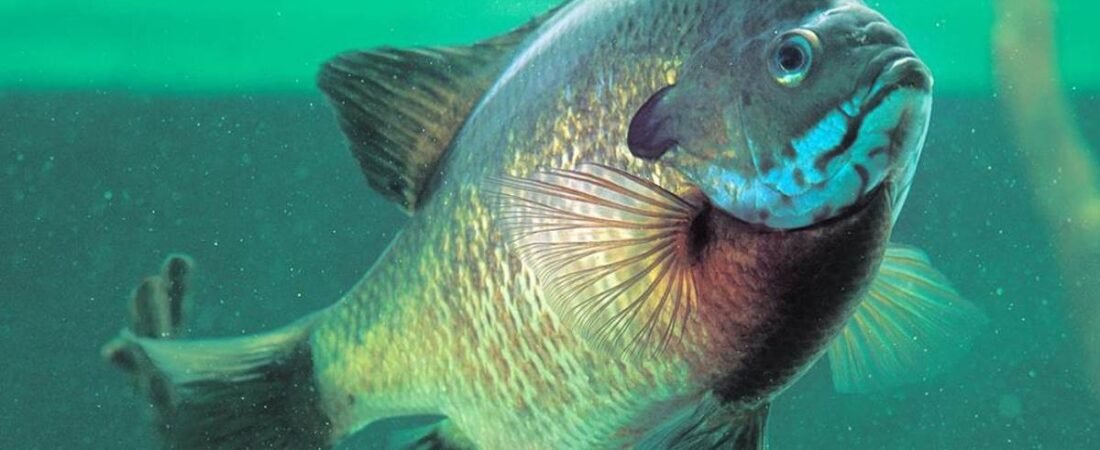
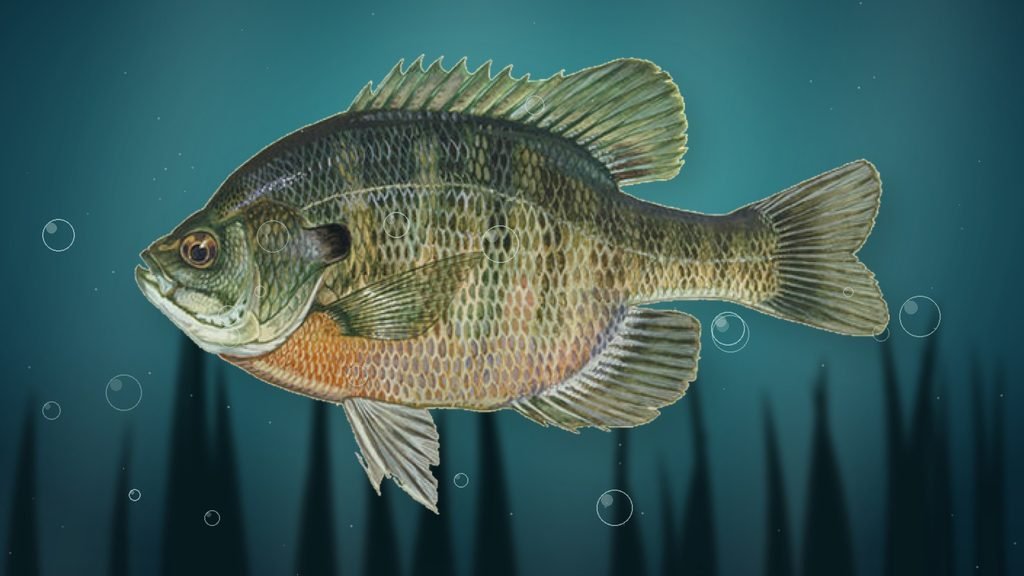
Bluegill are deep, flat-sided sunfish with a small mouth. The Iowa DNR notes the upper jaw does not reach the front of the eye when closed, and that the chin and gill covers are bright blue, which gives the fish its name. The back and sides are dark olive-green, and the breast and belly are yellow to reddish-orange.
Two details help most. First, a dark ear flap on the gill cover. Second, a dark spot at the rear of the soft dorsal fin, which the Michigan DNR says separates bluegill from other sunfish. Texas A&M adds that five to nine dark vertical bands run down the sides, and warns that color alone is an unreliable way to tell sunfish apart.
| Feature | Bluegill | Why it helps |
|---|---|---|
| Ear flap | Solid dark blue to black | Quick check on the gill cover |
| Dorsal fin spot | Dark spot at the rear of the soft dorsal fin | Separates bluegill from other sunfish (Michigan DNR) |
| Pectoral fin | Long and pointed | Noted by the Illinois DNR and Michigan DNR |
| Mouth | Small; upper jaw stops before the eye | Explains the small hooks and baits |
| Breeding male | Dark bluish-green back, rusty orange to red-orange breast | Bright colors in spring and summer |
Bluegill hybridize with pumpkinseed and green sunfish, and the offspring show traits in between (Michigan DNR). If a sunfish looks odd, it may be a hybrid, so check your state’s rules if limits differ by species.
Where bluegill live
Bluegill live in a wide range of waters. The Illinois DNR lists lakes, ponds, reservoirs, rivers, streams and swamps, and says they prefer warm, clear water with plenty of aquatic plants. The South Carolina DNR calls them very tolerant of many habitats, including creek and river pools, oxbow lakes and vegetated impoundment shorelines, and says they prefer sluggish or slow-moving water.
They stay near cover. The Michigan DNR lists weed beds, submerged logs and drop-offs, and the Iowa DNR says man-made structures such as stake beds, brush shelters, tire reefs, rock piles and docks attract them. Bluegill usually school; sources give group sizes of about 5 to 20 (Texas A&M) to 20 to 30 fish (Illinois DNR, Missouri Department of Conservation).
| Water type | What to look for |
|---|---|
| Ponds | Weed edges, docks, brush piles, shady banks |
| Lakes | Weed beds, drop-offs, docks, rock piles, submerged wood |
| Reservoirs | Shoreline cover, brush, points, humps |
| Slow rivers | Deeper pools, backwaters, stumps and fallen trees |
Bluegill are common across the continental United States largely through stocking. Texas A&M notes they can overpopulate small ponds, especially those under 1 acre, which can lead to stunted fish. The South Carolina DNR says crowded ponds can produce bluegill that only reach 4 to 5 inches.
What bluegill eat
Bluegill are mostly insect eaters. The Iowa DNR says they mainly eat slow-moving aquatic insects and rarely chase food. Texas A&M adds that insects and other invertebrates make up most of the diet throughout life, and that bluegill are sight feeders, mainly at dawn and dusk but willing to eat whenever food is available.
- Fry: zooplankton and algae (Michigan DNR), and small crustaceans (Missouri Department of Conservation).
- Adults: insects, small fish, crayfish and snails (Illinois DNR), with some plant matter.
- Feeding zone: they feed at the surface, in midwater and on the bottom. The Missouri Department of Conservation says they feed at the surface when mayflies are emerging.
Their small mouth limits what they can eat, which is why small baits work best. Our live bait vs artificial lures guide explains when each approach makes sense.
How big do bluegill get?
Most bluegill are small. Sources give slightly different averages: Texas A&M says adults typically reach 6 to 10 inches, the Michigan DNR says 6 to 8 inches with some reaching 10, the Illinois DNR says 8 to 10 inches and about one-fourth pound, and the South Carolina DNR says 5 to 10 inches and 3 to 8 ounces.
| Measure | Figure | Source |
|---|---|---|
| Typical length | 6 to 10 inches | Texas A&M AgriLife |
| Typical weight | 3 to 8 ounces | South Carolina DNR |
| Length at age 3 to 4 | About 6 inches (Missouri) | Missouri Department of Conservation |
| Iowa state record | 3 lb 2 oz (July 1986) | Iowa DNR |
| South Carolina state record | 3 lb 4 oz (1973) | South Carolina DNR |
| Texas state record | 2.02 pounds (1999) | Texas A&M AgriLife |
Growth rates vary widely with the growing season and food supply (Texas A&M), so we do not give one growth-by-age table. Lifespan also varies: the Illinois DNR and Michigan DNR give an average of 5 to 6 years, while the South Carolina DNR gives approximately 11 years.
The all-tackle world record is 4 pounds 12 ounces, caught by T.S. Hudson on April 9, 1950 at Ketona Lake near Tarrant, Alabama. It measured 15 inches long with an 18 1/4-inch girth (Game & Fish magazine). Another bluegill from the same lakes, caught by Coke McKenzie in May 1947, weighed 4 pounds 10 ounces after sitting in a refrigerator for about 20 hours, so its weight at capture is unknown.
Spawning and life cycle
Bluegill spawn in the shallows from late spring through summer. Sources give different temperature triggers: the Michigan DNR says spawning begins at about 65°F, Texas A&M says males move shallow near 67°F and spawning starts near 70°F, and the Iowa DNR and South Carolina DNR say 75°F. The season runs about May through August (Illinois DNR, South Carolina DNR), and Texas A&M says spawning continues periodically until early fall.
Males fan out saucer-shaped nests in sand, gravel or mud and guard the eggs. Nests form colonies, with 50 or more nests in one area (Texas A&M) and sometimes 100 or more (South Carolina DNR). The Iowa DNR says to look for beds in 2 to 6 feet of water.
Egg counts vary widely. The Illinois DNR says females lay 2,300 to 67,000 eggs, Texas A&M says 25,000 or more with an average closer to 12,000, and the South Carolina DNR says up to 80,000 eggs per year. Eggs hatch quickly, in 1 to 2 days in warm South Carolina water, 2 to 5 days under optimum temperatures (Texas A&M), and 5 to 10 days (Illinois DNR). Small “sneaker” males may slip into a larger male’s nest to fertilize eggs. Maturity is reached at 1 year (Illinois DNR) or 1 to 2 years (South Carolina DNR) in some sources, and at 2 to 4 years in the Michigan DNR account.
How to catch bluegill
Keep everything small. The Iowa DNR recommends an ultralight spinning rod with 2 or 4 pound-test monofilament, size 6 or 8 hooks, and small baits. Long-shank hooks are easier to remove from a small mouth, thin wire hooks keep live bait lively, and needle-nose pliers help with removal.
| Bait or lure | Best for | Notes |
|---|---|---|
| Worms | Beginners, any season | Classic live bait; use only an inch or two because of the small mouth (Iowa DNR) |
| Crickets and grasshoppers | Summer shorelines | Listed by the Iowa DNR |
| Tiny jigs, 1/32 and 1/64 ounce | Fish holding at set depths | Marabou, rubber grubs or twister tails; black and brown are popular (Iowa DNR) |
| Scented artificial baits | When you do not want to handle live bait | Listed by the Iowa DNR |
| Small bobber with hook or jig | Nesting fish and shallow cover | Set the float 2 to 4 feet deep and set the hook quickly (Iowa DNR) |
For bobber fishing, a simple rig is a small bobber, a split shot and a small hook. For drifting, the Iowa DNR suggests two lures tied 2 to 4 feet apart to cover different depths. Fish early or late in the day; the Missouri Department of Conservation says bluegill feed in the shallows in the morning and evening and move to deeper, shadier spots at midday.
Because bluegill are small, they are ideal for learning. See our guides on bank and pier fishing for beginners and kids fishing rod and reel combos.
Season by season
| Season | Where the fish are | What to try |
|---|---|---|
| Spring and early summer | Shallow, near nests (2 to 6 feet); aggressive | Best time per the Iowa DNR: worms or tiny jigs under a bobber |
| Mid-summer | 6 to 12 feet deep near weed edges, brush, rock piles and humps (Iowa DNR) | Drift or troll slowly; larger fish move deeper as water warms (Michigan DNR) |
| Late September into fall | Mid-depth areas such as shoreline points and ridges in 8 to 10 feet (Iowa DNR) | Small jigs or bait near points |
| Winter | 15 to 20 feet deep, or flats 10 to 12 feet deep to feed (Iowa DNR) | Active all winter, so a good target for winter anglers (Michigan DNR) |
Depths shift with the lake and the weather, so treat them as starting points and check local reports.
Gear to start with
Bluegill need light gear. An ultralight or light spinning outfit with light line is enough, and a simple setup is easier for kids.
- Rod and reel: a light spinning combo. See our best rod and reel combo for beginners, or the kids fishing rod and reel guide.
- Line: 2 to 4 pound-test mono is a common choice (Iowa DNR). See mono vs fluorocarbon vs braid.
- Knots: see our essential fishing knots.
- Tackle: bobbers, small hooks, split shot and tiny jigs. Our beginner tackle box checklist lists the basics.
If you are new to casting, see how to cast a spinning reel.
Rules and handling fish
Fishing rules vary by state and water body, and they change. Check your state wildlife agency for license requirements, size limits and daily limits before you fish. A freshwater fishing license is required in South Carolina, for example, and rules differ elsewhere.
Bluegill have small mouths, so use pliers to remove hooks gently, handle fish with wet hands and release them quickly if you are not keeping them. In small ponds, bluegill can overpopulate and become stunted, so some pond managers encourage harvesting fish within the local limits. Follow your state and pond owner’s guidance.
FAQ
What is the best bait for bluegill? Worms are the classic choice, according to the Iowa DNR. Tiny jigs in 1/32 and 1/64 ounce, crickets and grasshoppers also work.
What time of day is best? Morning and evening in the shallows, according to the Missouri Department of Conservation, with fish moving to deeper, shadier spots at midday.
How big is a typical bluegill? About 6 to 10 inches and 3 to 8 ounces in most sources. Fish over 10 inches are large.
Are bluegill good to eat? The Texas A&M and Missouri sources describe them as good eating, but check your state’s limits and any fish consumption advisories first.
Do bluegill bite in winter? Yes. The Michigan DNR says they stay active all winter, which makes them a good target for winter anglers.